Showing posts with label music. Show all posts

Tuesday, September 06, 2011

Not Drowning but Reading

I think I forgot how to read.

I think I developed -- what to call it -- an affective dyslexia. I could make letters into words, words into sentences, sentences into narratives, narratives into worlds. I could be excited, moved, engaged by what I read. Even made to gasp by its audacity, wit, anger, beauty. But still: I think I forgot how to read. How to read as I did when I was a child. How to be taken over by reading.

The only childhood photograph of me that still exists (there was a bonfire mandated by vanity) shows me in the corner of a hotel lounge, my hair falling over my face, my face turned down into the pages of a book. Out of the frame, undoubtedly, my siblings and the other kids staying at the hotel are running around making mayhem. I'm the girl in the corner.

The girl in the book.

She grew up, and to all intents and purposes remained the girl in the book. I've predicated my working life on reading: as an academic, a critic, a bookseller and a writer. But as reading has become work, it has lost its edge. An edge, because the imperative of articulation has also whetted reading's keenness for me, has made it social and reciprocal and pliable and playable. But a private has been foregone, an inwardness of the reading experience. A writer/critic can no longer be the girl in the corner: I am answerable to an (indeterminate, possibly fictional) public. And that's the whetstone that keeps me sharp.

Reading-writing enabled the girl to grow up *in* the book, but also to use the skills learnt therein to affect life beyond the pages. Books are no longer my only safe space. 'Reading', as a complex and rewarding labour of awareness and articulation, has superseded 'reading' as an immersive line of flight. It keeps me present and engaged. If I want to lose myself, there's music (which I don't make, and rarely write about), contemporary dance and live performances of all kinds.

So maybe it's no surprise that it took a book in which rock and roll fuses religion, politics and scientific breakthroughs to re-immerse me, to shake my senses, to absorb me completely that I'm missing bus stops, tripping down bus stairs, gasping up from the pages as if hauled out of a dream or the sea. For 'a book' read 'books': nothing more satisfying than a series, Gwyneth Jones' Bold as Love five-parter.

But the point here isn't to analyse or articulate why. It's to state the rush that has returned. Adults are supposed to put away childish things, like reading when they should be working/socialising/engaging in adulthood. But there is something that feels undeniably mature, more adult, in reading with the rush: being open to immersion. What was a necessity as a child now requires a kind of courage, to drop the critical armature. To risk (after a fashion) addiction.

What's that? The thrill of transgression? Fuck no, boring. It's the thrill of permission. The moment when the world says yes! to something they told you was impossible, was forbidden: more of that, always more of that. Gwyneth Jones, Band of Gypsys
A sexually-charged science fiction/fantasy hybrid with radical leftist politics (but more concerned with administrative detail), a sprawling narrative structure, narrative voice that drops in and out of different characters in close third (sometimes in the same paragraph): something they told you was impossible, something that works by its continual increase, its refusal of closure.

Wednesday, July 27, 2011

"Death is now. And now. And now," or, The Work of Life in the Age of Digital Pre-Production

This was written during the Liars' set at ATP: I'll Be Your Mirror on Sunday. I've just learnt the acronym TLDR [too long, didn't read] so warning: this is going to be a long post. The Liars, like many of the bands playing ATP, are pretty committed to sustain (Godspeed You! Black Emperor were averaging 15 minutes a song). I'll try not to drone on, but I want the post to reflect the immersive experience, the drench not just of NOIZE, although Swans in particular certainly brought that (to the extent that I've been feeling strange and deafened the last few days, like I should be hearing that constant barrage of sound), but of sustained attention and development. And the half-formed thoughts it prompted, which I am leaving somewhat fragmented, totally unsubstantiated and rather feedbacky. If you want a (partial) review of the event with some very atmospheric photos, check out the multi-contributor diary on Wears the Trousers, my favourite music blog. It's particularly good on PJ Harvey and Portishead.
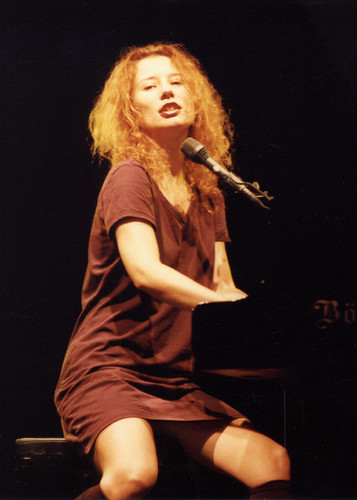
My ATP experience began with PJ Harvey on Saturday night (well, with the line-ups for chips, but let's skip that experience of duration), and with the odd realisation that I was framing my experience of the concert through the expectation that I would write about it here as part of the irregular series of female performers. That sense is nothing new, in a sense: I watch films and read books with pen in hand, even when not for publication. I've also reviewed dance and live theatre, but never live music (Birds' Eye View film and music extravaganza aside). While live music often prompts poem-thoughts and leads me to grappling for a notebook in my bag while going 'woooooooooh', it's not an experience that I filter critically or philosophically, despite adolescent plans to be a music journo. Being utterly unmusical, I can't Alex Ross it. It's embodied: sensory saturation (which isn't to say that its production and performance is unintellectual, or that I'm not learning and thinking). But while trying to catch a glimpse of PJ Harvey's extraordinary feather-hair arrangement, and feeling England shake, I was also framing her performance in words -- and, worse, in the viewfinder of my phone's camera. I should add that I'm a terrible and irregular photographer, but the iPhone camera works well for me (with its point-and-shoot absoluteness). So I took some crappy pictures of pixie people flared out in stage lights, more as a response to the crowd of camera screens waving in my vicinity than any internal compulsion.
Portishead and Godspeed You! Black Emperor both had video projections behind the band: Jem Cohen's impressively inchoate and melancholy films for the inscrutable Montréalers (whose sense of humour was abundantly demonstrated in their band bio in the programme, where they compared themselves to Rush), and faffy sub-Jem Cohen guff for the Bristolians. In between the lame films, Portishead did have live digital projection in over-exposed black-and-white, sometimes sequenced or mixed, but often extreme close-ups of Beth Gibbon. Film screens at large concerts, particularly festivals, are nothing new, but the use of grainy b/w appeared to be making a claim towards an affinity with Bertrand Tavernier's film Round Midnight and the jazz club photographs that inspired it -- and that also inspired the Super 8 depiction of the Velvet Underground scene. Think of Nick Cave performing in Wings of Desire. So it was a concert film that harked back to analogue grain and rawness, but being both captured and projected while the concert was ongoing.
Geoff Dyer refers to the quality of certain photographs as "the ongoing moment," a paradoxical perpetuity of the instant (or instantaneous eternity) that is a direct descendant of Roland Barthes' argument about the photographic punctum, the inscription of the photographic subject's death that makes portrait photography so moving. But these pictures were not being taken to be viewed, or reviewed, as mementos in the future, either the distant future after the subject's death, or the near future of communicating the experience to real-world friends. Instead, they were taken for the moment and for the immediate future: to review a minute or an hour later, to relive the concert that evening. Not as mementos to secure memory as it might fade, but as a record of an experience people were not having in its lived time.
There's a name - well, an acronym - for this kind of delay, and it's not TiVo. It's PTSD: post traumatic stress disorder, perhaps the defining condition of post-9/11 EuroWestern society, as this recent article by Gordon Turnbull suggests. In Precarious Life, Judith Butler suggests that the realisation that the West is as vulnerable as the Rest has prompted a kind of social PTSD, complete with repetition compulsion; Turnbull's article suggests the ways in which we can learn from trauma _not_ to repeat, instead to recognise our shared vulnerability: that is, our shared proximity to death.
Digital technology, as Laura Mulvey has suggested, a kind of death of death: the end of the stillness of the photographic still that makes up film, as well as the end of indexicality, whereby a photographic negative physically (that is, chemically) records the light bouncing off the subject of the photograph. The practical eradication of physical printing, as well as the development of wireless transmission, challenges the ongoingness of the photographic moment. Instead, the camera becomes an electronic amygdala: that is, it records what we can’t quite experience, and distributes it, diffusing its effect. Rather than be present in the moment of the music (and some of the moments, such as Swans, demanded intense presentness from the musicians and audience through their use of sustain, drone, build and volume), the digital photographer defers his or her experience, sharing it later in the ‘safe space’ of the online community. Their post asks – implicitly – exactly the questions posed by trauma survivors when their memories return: was I (t)here? What did I feel? What has it made me?
And, perhaps most crucially, how did I survive? Thinking about digital technology and/as amygdala gave me an intuition about the traumatic memory, the ‘shell shock’ dream images produced from/by photographic memory, which repeat always the same, unprocessed, uncondensed. Freud intuited that this meant the images had not been seen at the time; they had not been captured by the conscious and thus sent through the unconscious. Instead, the conscious mind had averted itself in order to survive a violent/violating experience. I think we can take this further: these are images the mind never expected to have to process, to store in memory. They are the images of the seconds before death, the unseen instants carried, eventually, by everyone: not the famous ‘life rushing before one’s eyes,’ but the precise circumstances of death. That which one would never expect to see. So to replay that black box record within one’s own mind raises the question: Am I dead? If I am, how can I remember? If I’m not, how can I not remember?
So these precious, tortuous images induce survivor’s guilt through their painful clarity, the very fact of their availability proving both that we are not dead, and that we should be. While it’s an exaggeration to claim that a music festival is a site of trauma that one must defer, and then mourn, it’s an exaggeration with at least three contributory thoughts: first of all, the volume of articles published each summer on how to prepare for attending such festivals (mainly shilling for specialised wellies, tents, earcans, etc), suggest that this is an event to be survived (although not necessarily survivable); one could go so far as to argue that, given the obsession with detailing the boggy conditions at Glastonbury, music festivals are described in the register of accounts of trench warfare from WWI, and may even be a cultural substitution for the rite of passage constituted by national service. They are certainly a version/descendant of the rambling/back to the land movement that started in Germany in the late nineteenth century as an outgrowth of Romanticism: the reification of ‘landscape’ and ‘nature’ as separate spheres from the urban, to be enjoyed by city folk en masse, sporadically and passively.
Reason two is, perhaps as a dark reflection of the war zone, the physical assault of noise and crowds that are generally regarded as unpleasant (say, in the London Underground), but welcomed at a festival as part of the authentic experience – although this experience can be differentially assaultive depending on your vulnerability. Despite utopian arguments to the contrary, festivals are temporary autonomous zones that (as ever) tend to favour the autonomy of those wishing to take power-over, as with the incidence of rape at Latitude last year.
The intense experience of being in a crowd of strangers, one where ordinary social controls and supervisions may not apply, is intensified or underlined by reason three: a year after the fatal crush at Love Parade, it was also hard not to be hyper-aware of the dangers of the crowd itself. Furthermore, the urban crowd has been, since Dresden at least – or maybe Peterloo, the target of military and militant assaults. A crowd is an attractive target. It was difficult, at ATP this weekend, not to think of Utøya: a similar autonomous zone, one where youth, music, exchange, and many of the ideas and beliefs reflected by the festival’s line-up were shared. To be in a crowd is thus to be vulnerable: to other individuals therein; to the mass movement; and to individuals outside.
So perhaps those digital photographers had the right idea: record now to watch later. But can you live life like TiVo? Watching the sea of digital phone cameras capture and immediately transmit (to Facebook, Twitter, Tumblr, MMS, etc) a film being immediately captured and transmitted, I wondered what had happened to death. Not least because of Harvey's "All and Everyone" with its standout line: "Death is now, and now, and now." That, I felt, was what missing. Not in the negative, Nietzchean, rather adolescent sense of "militant dysphoria" that Dominic Fox proposes, but as the defining, enlivening aspect of lived experience. The death that makes the music I heard at the festival so haunting and compelling: music at extremities of aural violence and vulnerability, spectral dynamics of sound and silence, of density and spareness. It was music that demands you stand to attention, salute it: the music of war and the mourning of war.
Harvey and Beth Gibbon of Portishead, in particular, as female frontwomen, not only take me back to my formative years in the mid-90s and so probably define my idea of female performance, but also seem haunted by an older tradition: they are both keeners. Professional mourners. Let England Shake is the album George W. Bush and Pericles would both have banned: an angry, provocative work of mourning for the war dead. A recognition and a cry for justice. A making-audible of the death that saturates the English landscape. Portishead have recently recorded a song for Amnesty International, and their oblique lyrics are often dense with a desire for decreation, or grief in the face of impossible loss.
As Wears the Trousers point out, both nights, “Wandering Star” was the stand-out song of their set. This unbearably fragile song of mourning, bleak and beautiful, was performed by Gibbon in a rocking crouch, her eyes drawn closed, her face turned down. Not the most expressive, outward performer (she hunches her shoulders and draws her belly in protectively while singing, and faces the back of the stage while not; in fact, her singing posture was uncannily similar to that of the burned, bowed body of Joan at the stake at the end of The Passion of Joan of Arc, which was screened, with live accompaniment, on Sunday afternoon), Gibbon appeared to cave in on herself for the most intense performance of the set. Uncommonly, the whooping crowd fell silent, even when the vocals dropped out (which prompted cheers and applause during all the other songs), in the presence of an intensity and rawness of feeling that – perhaps – we struggle to process, especially in the close proximity of so many (sweaty) others.
It’s the rawness of a collective mourning we no longer undertake, a collective witness to our vulnerability and connectedness. “Please could you stay awhile to share my grief,” the song asks. Death is now, and now, and now. This is what live performance demands: an affective, sensory apprehension of the layers of meaning in a ritual/performance, and our role in it, that is neither Dionysiac abandon (which inevitably leads to both risky and selfish behaviour, placing a premium on the expression of individual experience) or Apollonian triumphalism (which demands that the individual sublimate their experience into a cohesive performance directed towards a larger power). Obviously, blogging about this demonstrates that I have lost this sense/ability as much as anyone has, and that while trying to recapture it at ATP, I also found myself mourning it – and I have found myself grieving for the end of the festival since Sunday evening, when we heard the final notes of ‘Wandering Star’ and felt complete; sustained.
Through (re)writing these notes, I am seeking to reconnect to the brief glimpse of the needful network that sustains and shapes (not prescribes, commands or conforms, as religions and political parties do) the apprehension described above. Can there be a network without a system? A crowd without power? If there can, it must reside in the work of art itself, in its resistant liveness that defies the cultural determination that it has been staged in order to be instantly digitised. Performance, which contorts and absorbs the body, which makes shapes of yearning and desire, touches us kinaesthetically – not least with the desire to touch the performer, if only with our eyes. Sound, which moves through us in waves as light does not (which is why photography is possible), which is felt in the tympanum and the bones, which works on the nervous system, is a powerful medium for securing the interdependence of vulnerabilities necessary to be in the precarious now. And now. And now.

Sunday, July 10, 2011

Far from the Madding Crowd: Biophilia, Live Music, and Face Time


Welcome to another in this summer's irregular series of posts on women and live music performance. This one was prompted by a review of Bjork's show Biophilia that appeared on the F-Word. I saw the same show, on the same steamily humid day. Like Ruth Rosselson, I felt disappointed at first: distanced by the performance in the round framed by screen media (I found the videos inventive and distracting), music engines (likewise), the avenging angels of the choir (likewise and more so), and the Victorian architecture, which made me feel like I was at a cattle auction in a Hardy novel.

Which made me wonder: what exactly is it we're buying at live performances? Rosselson's review points out that the performance in the round meant that Bjork was facing away from 3/4 of the audience at any given moment, a gesture compounded or highlighted by her Braveheart/Boudicca-style wig and make-up. Like Rosselson, I found myself longing for face time: that intimate connection that seems promised by the yearning, direct, bodily intensity of Bjork's music. That faciality is the key mode of Western culture is a truth widely recognised, particularly in contrast to the place of the face in relation to identity in Islamic cultures. I found myself somewhat chastened to realise that what I was bidding for in my shuffling, head-winding position on the elevated terraces of the market hall was a chance to "own" a moment of Bjork's face, to "own" a direct connection with the singer/performer, as if she were singing directly to me.

That seduction is of course the predicate of musical and theatrical performance dating back at least to the eighteenth century and the appearance of women on stage in England in the Restoration: precariously paid and in social limbo, female performers were often perceived as prostitutes "offering" themselves on stage and off. That association, which was sometimes literalised under economic and social pressure, still haunts the presence of the female performer and the desire of the audience.

What's particularly interesting to me about Bjork's music -- and particular her new material -- is that, in all sorts of subtle ways, it plays with this desire and the idea of the face. David Attenborough's pre-recorded announcements -- brisk, associative, three-word captions -- couldn't be more different from his precise but flowing narration for BBC wildlife documentaries. Rather than naming and narrating species as they appear on screen (and particularly, with mammals, as their binocular vision engages ours), these captions present the theory or theme of the track that follows as an experiment rather than a confession.

Eye contact is a powerful experience, not only with a non-human Other whose eyes appear to offer recognition and reflect intelligence. It's one that shapes us from infancy in the maternal dyad, and one that can offer a guarantee of our existence and value in adulthood: but it is far from definitive. A partially-sighted person could have thrilled to the varied and palpable sound world of Biophilia, not least the absolute commitment of Bjork's voice to fill the space and engage her audience.

The video screens above the stage act as a reminder that confession is now (is always?) a mediated act, and our expectations of face time are not a nostalgia for an organic age of close connection with performers, but rather a product of cinematic technology, specifically the close-up and the video diary, which create the sense of public ownership over performers that generates paparazzi (Bjork has little patience with them as a species).

In place of this false nostalgia/claim to faciality, Bjork's new show offers a radical idea: biophilia. Love that relates to the life in liveness, not to appearance. The liveness of the voice as expression of embodiment, rather than the face. Of movement and co-operation (as when Bjork was surrounded by the choir as a mass of bodies) rather than the singular artist selling face time. Its radicalism stretches far beyond the commercial music business or issues of celebrity to speak to how we construct our relations with every aspect of the biosphere. Do we need eye contact with every refugee in order to protest draconian immigration regulations? Will we not save endangered animals unless we can have face time with them (every Friday, as per WWF's facebook stream)? Must something _have_ a face for us to engage with it -- to believe it is engaging with/imploring us?

Or can we read Bjork's costume and staging as a plea for escape from faciality: for returning the (pathless, faceless) rock to rock music?

Wednesday, May 18, 2011

Singing the Pirate's Gospel

...which is what I have been doing for the last week, since seeing Alela Diane at the Scala. I am an Alela nerd (yes, limited edition vinyls, SXSW sessions, semi-legal download of her unreleased first album; even an Alela-hand-made quilted T-shirt) but her new full-band project Wild Divine leaves me... hmmm. Part of it is that I think it would be weird to go on tour with your dad and your husband, but I have neither so who am I to say. And part of it is that the swinging 70s rock-out sound is not one that means much to me, compared with a girl and her guitar. Especially coming on after the support act -- a wildly brilliant, triple-drumming Peggy Sue, who played a kicking set while dressed in homage to John Hughes' movies that they are TOO YOUNG to have seen first time round, which was adorable/made me feel ancient -- the whole Fleetwood shtick felt old to me.

Which is maybe its point: homage, retro, etc. So why was it not as adorable to me as Peggy Sue's drummer rocking an Eric Stolz fedora? It's not like I love the 80s in any way. Alela, incidentally, was wearing a low-backed, knee-length fringed black dress. Her all-male band were in jeans. And there, for me, is the bind: that 70s sound is, well, kinda floozy. Maybe then it was in a good way, but now it seems to part of the flow of the sexualisation of women in the music industry rather than a protest against it. And here's the double bind: while Alela absolutely has the Lady of the Canyon voice to sell the songs, even over the great wash of guitar and bass that her producers have thumped her with (the bonus CD showcases the pre-wall of sound versions which grab me much more), but she can't channel Stevie Nicks via her hips.

And nor should she have to -- or feel she has to. But somehow that sound demands a performance of free love female sexuality. Which brought home to me just how far our perception of female performers in the music industry depends on how they perform with their bodies -- not just Rihanna and Xtina and etc., but ALL female performers. If they're folky, they're expected to be coy, virginal, or medieval: it's not just a beard/no-beard or plaid/no-plaid deal as it is for male performers, but about the interaction of the triad of their voices, their bodies and their accessories. And while many reams have been written on the agential performativity of sexuality by Madonna (etc., etc.) and, conversely, the sexualisation of male performers (differently) in hip hop and boy bands, I feel that it skirts the issue.

So I'm particularly excited by Peggy Sue and their keening monotone, which is full of desire and rage and anomie, and is queer without being Song of the Week on Glee. And also about seeing PJ Harvey later this summer, because Let England Shake doesn't just raise the envelope or push the bar or dance circles round the box of female performers' sexuality, it just walks straight past. Having screamed her desire for her ex-lover's "fucking ass" on A Woman A Man Walked By, perhaps she feels she's gone as far as she can with the straight-talking, SlutWalking style she pioneered. And it's not that the historical/geological palette of Let England Shake is _better_ than her unquestionably feminist and intensely exciting previous material, but that she's found a way to do something _different_ (following in the barefoot thoughtsteps of Patti Smith's Trampin' in some ways). Let England Shake's sense of the bodily as earthly/earthly as bodily -- in this case applied to mapping the traces of wars 'abroad' in England's landscape -- first appeared on White Chalk, where the wars were within a woman's body. The albums, for me, are a pair, and I'm intrigued to see how she'll follow up her White Chalk show which I saw at the Royal Festival Hall: Edwardian gown; toy instruments; soft-voiced, inter-song banter. How will she make Alexandra Park shake?

This all matters to me not only because pop music is a huge tranche of dominant culture and socialisation, but also because poetry, for me, is -- very deeply, almost unacknowledged -- a substitution or sublimation of my primary desire to be a singer-songwriter. Blame/congratulate my early exposure to Joni Mitchell and Carole King via my mum's own Lady of the Canyon period. Or my surprise encounter with Tori Amos pre-Little Earthquakes (and I'm very excited about the new Tori album AND about a Tori poetry tribute I'm going to be involved in this summer). Or discovering Tracy Chapman just when I needed her most. Or being arrested, breathless, by the video for Kristin Hersh's Your Ghost on MTV. Or even blame my parents for my Hebrew name, which means little bird. I've always wanted to sing but I'm beyond unmusical.

So poetry it is, but always in relation to that (r)evolving group of female musicians who dominate my stereo/iPod. Hence the question of performance and sexuality feels very personal: what to wear to a reading, which poems to choose (rude or not rude), how to banter/flirt -- all with the aim of "selling", which is itself, of course, highly sexualised, especially for women who are still perceived as selling themselves (ie: their sexuality; ie: the only thing they have -- although don't own) whenever they appear publicly. Which makes all the choices non-choices: Victorian nightie? Basque and chaps? Meat dress? It's always a complicitous critique because it engages in the discourse set up by patriarchy in which a woman is defined by what she wears, and is thus always defined as sexually available by dint of wearing clothes, as all clothing either reveals or conceals the body and can thus be interpreted as sexualised. This is what the SlutWalk is all about. And I am all for it.

But I feel like, rather than wanting/needing to wear a short skirt and clumpy boots (I spent my 20s doing just that, and it was great, actually), I need the outfit equivalent of Trampin' or Let England Shake: a performativity that doesn't even get into the argument, that says something different on its own terms. Any suggestions?

Wednesday, January 26, 2011

Squint Your Eyes and Look Closer, I'm Not Between You and Your Ambition

© Natalie Harrower, 2011.

Some weeks it's good to be a(n ageing) riot grrrl (woo grrrl, did this article from Friday's Guardian with "20 years ago" in the headline make me super-aware of my growing Sontag). But I'm not alone in growing old disgracefully and ever more riotously (can you be a riot wrrrrmrrrrn?). Carrie Brownstein, Sleater-Kinney badass, is writing a TV comedy series called Portlandia for IFC, which includes the (so, so untrue ;) Feminist Bookstore sketches (early versions can be seen at ThunderAnt). PJ Harvey has a growly-melodic wild new album (the aptly named Let England Shake) out soon, and Patti Smith said in an interview that she's been
listening to Polly Harvey's new song – she has this new song, The Words That Maketh Murder – what a great song. It just makes me happy to exist.
And, oh yes, this Saturday I went to see Ani Difranco in play a solo set in Dublin with my friend Natalie and a group of women from Running Amach.

Natalie and I worked out that we'd been to at least three of the same Ani gigs before we even knew each other -- bound by the solidarity of queer/feminist independent music (the Righteous Babe pose is pretty much the secret handshake you always wondered if queer women had to find each other ;). We also worked out that this was the best gig we'd seen for years: the most energised, inventive, alive and well, rioting. There were a couple of new songs -- Amendment and Promiscuity -- that offered complex, narrative analyses of politics and people as they entwine (the set list we reconstructed is here -- and more photos here, by Rosa Paolicelli).

Ani gigs, being a rare constant in a blurry, confusing life, often make me remember previous Ani gigs: the first one I saw (after winning tickets from DIVA!) in Shepherd's Bush in 1997, when she played "Swan Dive" and I instantly gave my heart to her (for some reason, I love songs where the female singer uses the word "tampon" -- blame riot grrrl). Or the first gig I saw in Canada, in the gym at the University of Guelph, two hours after being dumped; riding home on Coach Canada through the flattest flat fields in the world, listening to "Providence" and crying. Happy times. Whooping with a crowd the size of Lake Ontario outdoors at Fort York when she sang "To the Teeth," ending "I'm gonna take all my friends / Move to Canada / And die of old age" as the lights flared pink against the summer twilight. It was during Ani's set at the Cambridge Folk Festival in 2000 that I decided, for definite, to get my first tattoo; decided what it would be and where it would go. "Five foot two, wriggly and giggly," it feels sometimes like she's a livelier, brighter, more musical, more passionate (and more tattooed, although only just) version of me, leading the way out there.

Because -- confession -- long before I ever wanted to be a poet, I wanted (needed?) to be a singer. Raised on Joni and Carole by my child-of-the-sixties mother, I grew my hair long and wrote lyrics (boxes and boxes full o' lyrics) on my grandmother's old Olivetti typewriter, bashing away in my room to silence out everything else. Sadly, musical talent passed me by, and I couldn't master those teeny keyboards you got in going-home bags let alone a full-scale instrument (despite my passion for Jacqueline du Pré). So instead I committed the lyrics of Little Earthquakes to memory (and analysed them for months in my diary). And how excited am I about Tori bringing a musical to the National Theatre next year? Already saving money for a sleeping bag to camp out for tickets. Second confession: I know it's much cooler to be a riot grrrl, to worship at the altar of Patti Smith and PJ Harvey (and I do). But the wellspring of my poetry is a response to the more lyrical, more trebly, more folky, more (gulp) girly vocals and versification of Tori and Ani.

This blog post honestly feels like a form of coming out. The critical consensus on cultural cool is such that there is a canon of alt.rock acceptable to cite in poetry, or even describe as poetry - Bob Dylan, Leonard Cohen, Joy Division, maybe the Pixies. Patti Smith seems to have made it there since Trampin'; Paul Muldoon has a PJ Harvey poem. (Everyone has a Dylan poem.) But those flauntingly emotive, excoriatingly intimate, musically brilliant female singers? Not a chance (although Ruth Padel has a poem about Tori Amos' Bosendorfer piano). They don't really do irony. They don't really rawk. Their voices are high in the mix, their lyrics treble and tremble with confession and the contortions of conscience. They are about tampons and goddesses and mothers and abortions and not being a pretty girl. But still being a girl. If that's even possible. They want to know who you are.

They sing straight out to the audience, to you in the audience, to you at home in your room with your Walkman on trying really hard not to hear anything beyond the headphones. They say "excuse me, but can I be you for a while" and demand that you be present, you be really there. In poetry, the invocation of 'you' is called apostrophe, and Jonathan Culler argues that apostrophic address (‘O beloved as thou art! // O lift me from the grass!’ from Shelley's 'An Indian Girl's Love Song') is almost absent from contemporary poetry because it exemplifies ‘all that is most radical, embarrassing, pretentious, and mystificatory’ about the act of writing poetry -- of addressing intimate thoughts and visions to an assumed, absent audience. It's scary stuff. It means opening yourself up.

So if loving Ani and Tori is embarrassing and pretentious, which I can sometimes feel in hipster poetic company where I don't get every Dylan reference, then it's also radical and mystificatory because of its vulnerability, its openness to the possibility of being undone. Not a bruised, wounded drawl but tears. But the tattoo of a wedding ring. Something previously unheard and singing.

Thursday, December 04, 2008

Music: Not So Much the Food of Love, as Fuel of History [i.m. Odetta]

Congratulations to Alex Ross, passionate blogger, and winner of the Guardian First Book Award (among other accolades) for The Rest Is Noise, a history of the twentieth century in music. Yes, not a history of twentieth-century music, but a vast landscape of (well, primarily Euro-American) history through the compositions, lives and thoughts of the many men (and, like, two women) who reinvented classical music and the way that we hear.

The book thumped into my hands from the postman in April, a birthday gift from a music-loving friend delayed by - unbelievably - Amazon being continuously out of stock. Classical music is one of my great lacunae (I mean, like a Great Lake-una) despite having studied with Linda Hutcheon, one of the foremost opera theorists. I'm a tone-deaf, word-loving, visually-stimulated fidget and really *listening* is not something that comes naturally to me. All the classical music that I know is directly attributable to its use in films: Pergolesi's Stabat Mater in Jésus de Montréal; Astor Piazzolla's tangos in The Tango Lesson; the Gymnopédies in just about everything.

So, I expected the book to be a huge challenge, although I'd enjoyed reading performance reviews on Ross' blog. But it was exhilarating (although time-consuming because I had to read the paragraphs about diminished eighths several times) -- I'm not sure how to hear some of the musical twiddles that he discusses so ably, but I have a strong sense of what they might mean, not only as bird-flipping to the history of music (and its stuffier critics), but as agonised or ecstatic autobiographical and/or political expression, especially in his painstaking study of Shostakovich's relationship to the Revolution.

What's so exciting about Ross' book -- and frankly, so Guardian-y -- is that he puts politics, and personal politics, back into music, with a particular emphasis on (and love for?) composers on the left (not the party, partisan Left), and with a subtextual thread running through the book about homosexuality and 20th century music, which he writes about most affectingly when discussing Benjamin Britten and John Cage (not together). It's not an all-out "queering" of modernist music, but there is a subtle argument (I think) about the suppression of identity, both personal and political, that canon-making demands.

It makes for great history as well: the sweeping chapter on music-making and the Alphabet Agencies, and about African-American composers before the war, left a deep impression on me (see my previous post about contemporaneous labour poet Genevieve Taggard), although Ross is clear about the project's ultimate failure. And the history of Weimar unfolded thrillingly differently when read through the swirling schools of competing German (and German-Jewish) composers. (Once the book hits the Cold War and its stochastic sounds, it lost its impact a little for me, although I enjoyed the description's of Cage at work).

Considering twentieth-century music demands something more than musicology, and Ross starts the book with the need to understand Wagner and his unique place in music and history, opening up the question of the ways in which music can shape national identity and can be used as propaganda (see above re: Shostakovich), but also an international language of exchange and co-operation.

And also protest: although Ross treats lightly the place of popular music in political and cultural history, (although he does end the book with a shout-out to Bjork), his account of the various musical agencies put together by FDR presages (and gives a historical context to) both Alan Lomax's work (which he does discuss, briefly) recording American folk, and the folk revival of the 60s and 70s, as music and the civil rights movement entwined. By a fluke of history, Ross' win co-incides with the death of a singer whose career exemplifies the undercurrent of music in American popular history, Odetta.

It's a shame that Ross didn't cast his net a little wider, into contexts where women musicians, and musicians of colour, were making the waves (although the success of recent books like Hand Me My Travellin' Shoes and In Search of the Blues, as well as PBS' series on the blues, suggests a burgeoning interest, and a refusal to let these histories disappear -- all three depend -- and thrive -- on oral history). The real threat of that loss is flagged up by a story in caustic style by today's Guardian diary:
More evidence of year zero at the BBC arises from discussions with Bewick Films, the Northumbrian independent, which saw significance in the 70th anniversary of Billie Holliday first singing the classic Strange Fruit, with its images of slavery, and the inauguration of America's first African American president. They suggested a documentary examining the role of the song in the civil rights struggle, which was considerable. Some believe it was a better anthem than "We Shall Overcome". Wasn't this, they said, a perfect idea for BBC4's musically themed Friday nights? Err, no, for "unfortunately the channel feels that there is insufficient appetite" for a Holliday documentary. Moreover, "His career is well served within the BBC archive." Still, for real fans, Billie's legacy endures. We miss him.
Blood on the leaves, blood at the roots: a history that need writing and writing again.