Monday, January 07, 2013

Wanna Be in My Gang?: Reading Girl Gangs & the Problem of Violence

Foxfire, dir. Laurent Cantet, 2012. Adapted from Joyce Carol Oates' novel, Foxfire.

Everyone loves a girl gang, right?

I ask because posters for Foxfire followed me around Paris this yearturn as I read:

Sylvia Townsend Warner, The Corner that Held Them (C14th nuns)
Kate Mosse, Citadel (all-female Resistance group in Languedoc)
Alice Hoffman, The Dovekeepers (four women in Masada)
Octavia Butler, Parable of the Sower (female Messiah on post-apocalyptic Pacific coast)

Girl gangs - monstrous regiments of women - nunneries - dovecotes: whatever you want to call them, the idea of a group of women working together towards a powerful and public project fascinates us because, I think, it's so rarely portrayed in our culture. All of these books explore the particular loyalties, tensions and strengths that connect these groups under the deformative pressure of patriarchy (call it Nazism, the Church, apocalypse or the Romans, as you will), but they are unsettled when investigating the question of how women might fight back against this pressure: all, as writers, have chosen the word, and yet the fascination with the sword remains.

Earlier this autumn, I spent some time thinking about Lizzie Borden's 1982 film, Born in Flames, about a group of women who organize in New York City against a stultified socialist revolution. Borden's characters train for violent resistance, but are shown using it as a threat rather than actualising it, instead targeting media and raising consciousness through anarchist tactics.


Butler's Parable and Borden's Born in Flames share many resonances, not least their diverse characters, with a radical emphasis on African-American and Latina women as activists and leaders. They are also both science fictions of the near and possible future, whereas the other three books are historical fiction. All of the books are also - broadly, and unlike Born in Flames - concerned with religion, as both social construct and faith.

Why put together girl (or girl-led) gangs and religion (Judaism and Christianity, to be specific)? There's no doubt that a powerful charge arises from telling women's stories in the most unlikely settings: and not just the story of a singular, outstanding woman but of women interacting with each other, and - in the case of The Dovekeepers in particular - of women's knowledge (keshaphim, women's magic) and its oral, inter-generational transmission.

But that camaraderie, which in itself forms a kind of resistance to the patriarchal world (even in The Corner That Held Them, where the nuns spend a good deal of time wanting to escape the cloister), is shaded by another type of resistance, one that sits - I find - uneasily with it: that of violence. Aziza, one of the four dovekeepers (whose role suggests their connection to peace), dresses as a man in order to fight in her brother's place, for example. Alongside this gender slippage - which Hoffman handles very powerfully, as Aziza finds love with another warrior who accepts her as transgendered - there is another performance, particularly in Citadel, in which the women use hyper-femininity (or "feminine wiles") to carry out their plans for sabotage.

I can't quite put my finger on what unsettles me about the triangulation of magical/occult camaraderie, breech-part violence and hyper-feminine espionage, but I think something about it disturbs both Mosse and Hoffman as well, who provide spectacularly punitive endings to their (very long, absorbing, close third person) novels. The death of Sandrine, the protagonist in Citadel, is practically pornographic in its intimate physical detail: a grenade lands by her thigh. Is it that women are to be punished for trespassing on male territory? Or a restatement that war is bad and women its victims?

Only Butler and Borden fully explore the analogy that these stories might be making between war and gender politics: that of "sleeping with the enemy." In Butler's Kindred, this is also explored across race and class lines in the antebellum South. Warner, by walling her women into a convent and showing how they both thrive and chafe, creates a fascinating ambivalence, as she does in Summer Will Show, her tour-de-force about a lesbian couple involved in the Paris Commune, about the intimacy of women and history.

What Warner and Butler reflect in their stories, and Hoffman and Mosse struggle with, is that neither intimate nor political relations can be equal until society is; all four novels show groups of women struggling against inequality in all its violence, but Mosse, in particular, turns that violence in on her characters rather than propose or investigate a radical social shift. Writing historical fiction makes that difficult, of course - but Warner manages it in Summer Will Show, as her protagonist sits down to read the opening of the Communist Manifesto.

I wish I had as satisfying yet open an ending to this post. I suspect my enthusiasm for girl gangs - for reading about girls in books, and seeing girls on screen - will burn and burn.

Wednesday, December 26, 2012

The Veiled Detective: Sherlock Holmes (&) the New Woman

So Arthur Conan Doyle based his detective duo on a lizard from the dawn of time and her wife. Madame Vastra, a Silurian (lizard-looking alien who eats humans), is known as the Great Detective (she tracked and ate Jack the Ripper) and Jenny, a Victorian human, is a sword-fighting former match girl.

Or, merry Christmas from Steven Moffatt, current Doctor Who (and Sherlock) showrunner, doing his bit for equal marriage rights. In yesterday's Christmas episode, The Snowmen, the dynamic duo were greeted by villain Dr. Simeon with the reveal that Vastra, known also as the Veiled Detective, was Doyle's inspiration. An in-jokey cross-reference of course, but also - possibly - an admission from Moffatt that there something missing in the state of Sherlock. As there has been in Doctor Who: this is not the time or post to go into everything groanworthy about Moffatt's Whovian arc, but briefly: everything, and particularly his treatment of female characters who are never... themselves. Clara Oswin Oswald, the new companion, looks like she'll present a similar problem, being an impossibility (the girl who died twice) who, far from being a vampire slayer, will be a temporal impurity the Doctor will have to erase.

Dialling back the predictions, though, it's safe to say that Moffatt has a problem with women. Or rather,  with girls who become women. It's all marvellous when she is Amelia in her nightdress or Jeanne Poisson in her nightdress (hmmm), but as soon as these spitfire girls - who need the Doctor as a protector - attain womanhood (or at least adolescence) they become something threatening: sexual beings who snog the Doctor and dizzy him. And so they must be abandoned, duplicated, sacrificed, fragmented (River), married off (Rory!), or otherwise written out.

Now, obviously, the character of the Doctor as conceived since the dawn of time, is an escapist bachelor fantasy: one that Moffatt also identifies in Sherlock Holmes. His Sherlock is, to me, as problematic as his Doctor. The writing might be sharper in the former than the latter, but the characterisation depends, again, on such a limited and depressing gendered binary that I find it unwatchable. Again, further analysis is for another time.

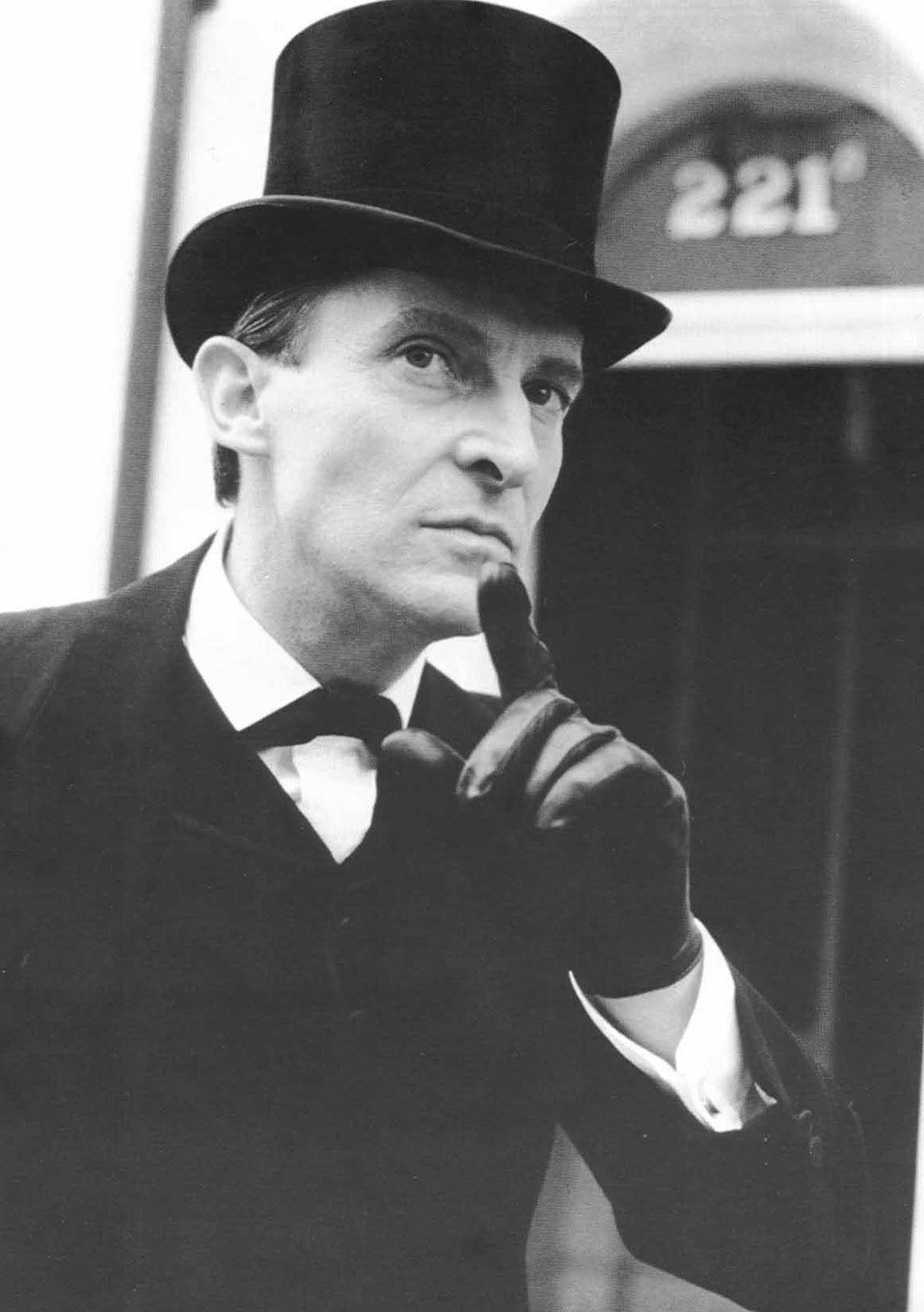
Because my Moffatt-bashing may have something to do with my absolute devotion to the one, the only incarnation of Sherlock Holmes: the magnificent Jeremy Brett. I grew up with Brett's Holmes, from 1984 to 1994, all 2358 minutes (approx., according to the box set) of aquiline deduction and irascible line deliveries. Whether the codex or televisual Holmes came first to my consciousness is lost in the mists of times: they are intertwined. My uncle gave me the Penguin Collected Sherlock Holmes when I was still at primary school; in my final year, I won the public speaking competition as Holmes, with a riddling speech in the first person leading up to the declaration, "Who am I? It's elementary."

I was a strange child, and I still am. The postcard from the Sherlock Holmes museum, which informed me that Mr. Holmes could not answer my question because he had retired to keep bees in Sussex, still rankles in its insinuation that I couldn't tell fact from fiction. I was a Holmesian: astutely in tune to the crucial distinctions between the real and imagined.

Rewatching the entire 2358 minutes of Brett's Holmes earlier this year, I was amazed by how fallible my memory of the series was, given my devotion to it, but also by how vivid. Fragments, moments, expressions, phrasings persist where plots had fallen away. Unlike many avid Doyle readers, I never became a fan of detective fiction. It wasn't Holmes' deductive method, or the tangled webs from which he extricated himself, that interested me.

What was it? I've been wondering all year how to describe, or even identify, it. From the off, though, the ordering of the ITV adaptations hinted at something confirmed by the magnificent, melancholy concluding episodes: Holmes, like his exact contemporary Sigmund Freud (who moved from physiological to mental deduction), listens to women. In fact, he listens "like a woman" (to quote, contingently, cultural norms).

Moffatt's Sherlock, among his other deficiencies, does not: he is rude, abrasive, disengaged. Debates have raged online about whether his Watson's joking reference to autism is in fact intended as a diagnosis, with fewer debates about the complexities of what this means - from the stereotyping of the autistic 'savant' to the mechanisms of autism. Whether Moffatt's and Benedict Cumberbatch's Sherlock is intended to be an autistic character or not, he behaves brusquely and even brutishly towards the emotions and imaginations of others. Brett's Holmes is, rather, like a taut violin string sensitive to every emotion and imagining around him: hence his brusqueness, not because he is unaware, but because he is too aware.

And with this awareness, like Freud, what he hears is the plight of middle-class women, often New Women. The ITV cycle begins with A Scandal in Bohemia, the first short story to be published in The Strand Magazine in 1891. In it, Holmes meets his match, not in Moriarty, but in Irene Adler, a woman of exceptional intelligence and courage, determined to pursue her feelings against social norms: she turns down the affections of a king. Holmes, commissioned by the king to steal back a photograph from this woman out of fear of blackmail, ends up switching sides. In Moffatt's version of the story, A Scandal in Belgravia, the female suspect is wily and manipulative, using her erotic capital to both flummox and inform Holmes - who is beaten by her, but does not respect her.

Brett's Holmes harbours a Platonic love for Adler, evinced by his possession of a photograph of her, hidden in a drawer as her photograph of the King was hidden in a safe. Holmes does not save Adler (she does that herself), but he keeps her safe, one could say. Subsequent episodes in the first ITV run, entitled The Adventures of Sherlock Holmes and not even vaguely related to publication order (only sampling the published collection known by the same title), feature similarly bold, brave women to whom Holmes increasingly lends a sympathetic ear.

There are wives who fear the return of the repressed (for example, in the second episode The Dancing Men) or disgrace attendant on their dependence on their husband (third episode The Naval Treaty). But there are particularly young, unmarried New Women, threatened by indeterminate and suggestive forces. Episode four, The Solitary Cyclist, focuses on Violet Smith, a middle-class young woman impoverished by her father's death, and working as a music teacher to provide for her mother and earn enough to marry her fiancé. Cycling to the railway station to take the train to her mother's, she is followed by an unidentified male cyclist, whom she suspects of being either her employer or his boorish guest, both of whom have expressed a competing attraction to her.

What saves this from being an all-too-familiar tale of the (depicted as) self-inflicted peril of the unmarried woman daring to be out in the world is Holmes' attention to the details of Smith's case, the way in which he treats her, first of all as a serious client even though she is not wealthy; and second of all as a serious and credible witness to her own almost supernatural circumstance. It was only in the 1880s and 1890s that the safety cycle had attracted women to bicycling in great numbers, providing - in tandem with the railway - freedom of movement for the increasing numbers of working middle-class women. Violet Smith is a model of such a woman, and the story offers a sympathetic and ultimately vindicating account of the threat posed by and to the New Woman by hardened Victorian patriarchal attitudes. Smith's forced marriage is annulled, her fortune is rightly inherited and the two competing suitors are both punished. It's an upside-down fairy tale, one that depends not only on Holmes' deductive skills but on his willingness to trust Smith, and hers to participate, dangerously, as bait.

That danger is multiplied in The Speckled Band, one of the creepiest of Doyle's stories - and perhaps the most Freudian, featuring mirroring sisters, a death on the eve of a wedding, and - finally - a snake that slithers from a stepfather's bedroom and down a bell-pull. Helen Stoner, another young fiancée living precariously in the house of a man who is neither father nor husband, braves her stepfather's considerable disapproval to contact Holmes; in fact, he follows her to Holmes' office and demands to know what she's told the detective. In this, even before the snake appears, Dr. Roylott comes across as the classic sexual abuser. Words can't describe the satisfaction of Holmes striking Roylott's swamp adder and sending it back through the ventilation shaft to bite its owner.

Like Freud, Holmes appears to identify and refuse to indemnify the source of his young female clients' oppression and terror: the older men who hold monetary and social power over them. In another Adventures episode, The Copper Beeches, governess Violet Hunter (a first featured TV role for Natasha Richardson) finds herself the subject of strange, quasi-sexual ministrations by her employer, only to discover (at considerable personal danger) that she is impersonating the locked-up daughter of the house: a profound and clever pastiche of all those "madwoman in the attic" novels.

It's a trope that appears again in The Eligible Bachelor, one of the most ambitious of the ITV adaptations, a film-length episode that takes the fairly simple Holmes story The Noble Bachelor and meshes it with elements borrowed from other stories, as well as inventions. In the opening act, Holmes attends a rehearsal of an Ibsen play (Hedda Gabler, I think), a signature embodiment of the Woman Question and women's contemporaneous struggles for self-determination. The lead actress, Flora Miller, becomes a character in the story - an informant - but it is with a darker, Gothic fantasy that the episode concludes. The bright young American bride-to-be (an echo of American opera singer Irene Adler, perhaps), Hetty Doran, disappears and reappears, persuaded by Holmes to undertake that dangerous adventure of being bait that appears in The Solitary Cyclist and The Speckled Band. Wandering through the guignol fantasia of her betrothed's abandoned country house, she is chased by a leopard (there's also a leopard in The Speckled Band), which leads Holmes to an animal pit that conceals Lord Robert St. Simon's first wife, whom he had committed and then - when she was maddened by confinement - returned to his estate where she was caged like an animal.

A truly remarkable woman, Amelia has sustained her sanity by turning her cage into a trap - intended for St. Simon. With Holmes' help, she escapes, and in the final shot of the episode, she attends the opera (another Adler reference) with him. Many viewers deride the episode, in common with many directed by Peter Hammond, for its hammy inclusion of such Gothic elements, its pick-n-mix approach to adaptation, and its use of the supernatural: Amelia appears to Holmes in dreams that lead him into a depression: he believes an animalistic woman is coming to destroy him. Watson even suggests that Holmes consult a Viennese doctor, Sigmund Freud, about these dreams. But Hammond and screenwriter T. R. Bowen invert the dream's apparent vision of the castrating woman, by having Holmes and Amelia rescue each other: he rescues her physically, but she rescues him spiritually.

Among other stories, The Eligible Bachelor borrows from Doyle's The Veiled Lodger, bringing us back to Madame Vastra and Moffatt's counter-intuitive insight given his own depiction of Holmes. Veiled within the great detective is not only a sensitivity, but an attunement to the Woman Question (equality of education, employment and independence) that lies at the heart of some of the greatest Holmes stories. ITV's adaptation, perhaps fuelled by the second wave of feminism in the 1970s, brings this strand out. The plot is almost always the same, whether in The Hound of the Baskervilles (another version flubbed by Moffatt) or The Master Blackmailer: double standards and asymmetrical power. The solution that compelled - and compels - me is not the unravelling of the crime but the stark and subtle reveal of the far greater power behind the crime: not Moriarty, but patriarchy.

Like Freud, who changed his mind about seduction theory under social pressure, Doyle was a man of his time, both alive to inequality and - in other ways - blind to it. It's undeniable that the Holmes of the stories can also be classist, racist and sexist, dismissing people as inadequate based on a few trace facts about their identity. Franco Moretti has shown that Doyle's crime map of London bears no resemblance to the recorded criminal activity reported by Scotland Yard and the media, but rather an instinctual bias against working class people and immigrants. But the ITV series - and here credit must go, I think, to Brett as the one constant as directors and screenwriters changed around him - finds a Holmes that resonates deeply with a century of change: Holmes, (friend of) the New Woman.

Tuesday, December 11, 2012

Nowhere or Now Here: William Morris' Utopia

'Strangely?' said he. 'Is it strange to sympathise with the year and its gains and losses?'
There's not many science fiction novels whose plot motor is getting upriver for the harvest. Maybe only one: William Morris' News from Nowhere, first published as a book in 1890. It opens with a disgruntled man leaving a Socialist meeting in London, where discussions "as to what would happen on the Morrow of the Revolution" had turned into a petty argument. He walks home to Hammersmith, and wakes up the next morning a century in the future, on that morrow. He travels through London and then down the Thames with a friendly utopian, shipping up at Kelmscott Manor, Morris' own house of later life. At the culmination of the book - at a harvest feast in Kelmscott's village church - the narrator simply fades from his companions' awareness, returning to his house in present-day Hammersmith.

It's an incredibly efficient and effective narrative device, one that opens up the real motor of the novel: how did the world change? And how does that change follow from, and bear out, Morris' own practical and political socialism.

Morris' first person narrator is at once overwhelmed with happiness and apprehensive about the post-industrial, post-capitalist egalitarian utopia in which he has awoken, and it's this combination of delight and melancholy (that change has not been achieved in his own time) that draws the reader on through long dialogues with utopian citizens. Morris breaks that hoary saw "show don't tell" endlessly: his characters, who predominantly disapprove of books, turn telling (back) into a vivid art. There are didactic strictures on labour, class, exchange and architecture, and plenty of them, but they are delivered in character and in tonal harmony.

Morris places some excellent and entertaining (to me) rants about the novel as a form in various characters' mouths. While art, architecture and craft - indeed, all forms of physical and material beauty - are highly valued in the novel, the linguistic arts, whether conversation or letters, are looked on with suspicion, giving the novel a curiously astringent character, an asperity towards its own means. And indeed, as a literary work, it fulfils the contract it sets out by not falling into any of the traps it identifies. Here Ellen, the most perceptive of the utopians, the only one who can see that the narrator is from the past, comments frankly:
As for your books, they were well enough for your times when intelligent people had but little else in which they could take pleasure, and when they must needs supplement the sordid miseries of their own lives with imaginations of the lives of other people. But I say flatly that in spite of all their cleverness and vigour, and capacity for storytelling, there is something loathsome about them. Some of them, indeed, do here and there show feeling for those whom the history-books call 'poor,' and of the misery of whose lives we have some inkling; but presently they give it up, and towards the end of the story we must be contented to see the hero and heroine living happily in an island of bliss on other people's troubles; and that after a long series of sham troubles (or mostly sham) of their own making, illustrated by dreary introspective nonsense about their feelings and aspirations, and all the rest of it; while the rest of the world must even then have gone on its way, and dug and sewed and baked and built and carpentered around these useless - animals.
Take that, Jane Austen. Ellen is also perceptive as to the effects of this cultural production on the minds that absorb it, noting later that the narrator ' "nurse[s] a sham sorrow, like the ridiculous characters in some of those queer old novels." ' She's right: and it's part of what's gripping about the second half of the novel: the narrator's absolute conviction that he will lose, or be dismissed from, this utopia. Ellen identifies it as a self-fulfilling prophecy: the narrator is held back from his full participation in the utopia by his conviction that he must lose it, that he is unworthy or unwelcome, and also right that this mode of thought derives from his cultural background. He cannot prise himself out of the narrative mode and shape with to he is accustomed.

But the narrator experiences his awakening as a wake-up call. Morris was deeply familiar with medieval poetry (not least through the creation of the Kelmscott Chaucer), and the motif of the spiritual dream in which the dreamer is saddened to awake from his vision of heaven, but also invigorated by awakening with his new knowledge, is echoed by the end of the book. The narrator remembers 'Ellen's last mournful look' and interprets it as handing him a mission for his return, to work towards the realisation of the future he has seen. So the experience narrated by the book takes its place as the 'dream' intended by medieval poets, rather than Symbolist or (given the book was published in 1890) psychoanalytic writers: as a revealed reality, experienced through intense longing.
Yes, surely! and if others can see it as I have seen it, then it may be called a vision rather than a dream.
With this final sentence, News from Nowhere also sets out a new vision of the novel as utopian form or project: not to draw the reader in through a cascade of inorganic crises and tensions leading to  a normative and normalising resolution, but to present its world-building as a vision: detailed, and even dove-tailed, as Morris' narrative architecture is. Why shouldn't the year's gains and losses be as effective and intriguing a rhythm for narrative as the three-act structure?

Sunday, November 25, 2012

The Revolution Will Not Be Fantasised: G. Willow Wilson's Alif the Unseen

I'm very glad that Alif the Unseen exists - and indeed, glad that its author G. Willow Wilson exists and is making work in comics and fiction. What she says of the Arab Spring -- "For good or ill, those kids were imagining a brave new world" -- is also true of her work. Alif the Unseen is an exciting, credible and witty fusion of Cory Doctorow's Little Brother, Philip Pullman's The Golden Compass, and the films, blogs and fiction that have come pouring out of the Arab Spring. It's full of gorgeous ideas about metaphor as world-coding (like China Mieville's Embassytown) and about reversing the Enlightenment cleaving of the rational, empirical world from the spiritual (or science fiction from fantasy, to put it generically). The best, most paradigmatic line in the book is probably when a shadow-djinn in the sideways spirit world of the Empty Quarter tells Alif, the hacktivist protagonist: "Brother, we have Wifi."

I'm with Willow Wilson in her take on Asimov's third law --"Any sufficiently advanced technology is indistinguishable from magic" -- which is that any technology, from making fire onwards, is magic; that is, an extension of the human imagination made possible. There's a lovely scene where an imam explains to Alif that scholars considering the laws concerning travel to Mecca predicted, legislatively, air travel by several centuries. Technology actualises imagination one way; magic another; fictional writing partakes of both. Human cultures include both, strategically as it serves them, and often make technology in the image of magic, and vice versa.

So why did I feel dissatisfied at the end of the book -- a book, moreover, in which a book is all-powerful; in which language is revered; in which politics are foregrounded? I wonder if it's because the book-within-a-book highlights another division, one that transcends genres and the whole "science fiction is more radical than fantasy because it's futurological, technological, rationalist / fantasy is more holistic than science fiction because it embraces and expands tradition/history, is non-teleological, non-techno-fetishist" blah blah blah. The book-within-a-book is Alf Yeom Wa Yeom, Wilson's fictional counterpart to Alf Layla Wa Layla, or The Thousand and One [Arabian] Nights. The Alf Yeom is a classic narrative device, like the Ring of Power in Lord of the Rings: stolen, powerful, ambiguous, carried by an innocent who gradually taps into its power. It drives character development and action.

Yet Wilson also goes William Gibson/Kathy Acker/Samuel Delany/Mieville and suggests the book does more: it can hack reality. Not just through its ideas (which is fortunate, as Wilson's attempt to write allegorical, multivalent tales on the model of Alf Layla is a little embarrassing) but through its linguistic and narrative properties. The idea of the book-as-code (and the story-as-code) is not a new one, but Wilson runs with it impressively. Until she doesn't: the book fails as code, the world doesn't change, and it's left to old-school narrative fiction and its car chase/dream/fight/puzzle tropes to save the day.

The book doesn't follow through formally on what it's saying narratively, in other words. It's not a multivalent allegory, nor - like Acker's Empire of the Senseless - does it hack language and linear narrative as codes that structure the world. Instead - details of Gulf culture aside - it reproduces them. As the argument runs, car chases and shoot-outs make accessible radical material (the fusion of Islam and computer technology) that readers might otherwise resist. But master's tools, master's house: reproducing the form of EuroWestern science fiction, down to its getting-the-girl ending, is frustrating; it's just as frustrating in Doctorow's Little Brother, which argues for revolution but faithfully reproduces the beats of conventional narrative (less successfully than Wilson does, although her fight scenes are rather confused and desultory).

On the other hand, readers hardly flock to Delany or Acker, says conventional wisdom -- aka, the accountants at publishers. It's true that His Dark Materials spread critical thinking about fundamentalisms far and wide -- but ultimately, the books were broadly palatable and their political message dulled by their narrative imperatives. Thus, I think there is an argument for relocating the binary, if we need to have one, not between science fiction and fantasy, but between books that follow conventional narrative structure (as inherited from the Victorian novel via Hollywood cinema), often with didactic purpose; and books that take the premise of their content seriously in allowing it to affect their form, so a novel isn't just about hacking, it's hacked -- it's not just drawing material from sagas, it explores the saga form.

What's radical is not only the ideas a book puts in the mouth of its characters, but whether it puts its money where its mouth is, and lets those ideas change the novel itself. Wilson appears to explore this through the Alf Yeom, with its allegories imparted through interactive oral storytelling, but in the end the story tells us explicitly that this revolution - in which metaphors fully mean, in which their multivalence is realised as the structure of reality, in which imagination and the empirical world are recognised as mutually constitutive and thus fiction can hack RL - makes the world unstable. And that applies, it seems from the final chapters, to other revolutions too...

Sunday, September 16, 2012

Trains, Janes and Automobiles: Variations on a (Jane) Eyre

I haven't quite finished Margot Livesey's The Flight of Gemma Hardy, but I wanted to write this now (just in case I'm reading the book's signals wrong and it doesn't follow through on its line of flight from Jane Eyre). Gemma is an orphan raised and then cast out by her aunt, schooled at a brutal boarding school, then hired as au pair to a motherless child in an isolated great house. Eighteen and starved of affection, she is swept off her feet by her wordly, wealthy employer, only to have their hasty wedding halted by a revelation that causes her to flee -- almost to her death. Cared for by a rural family, she is torn between a desire to make a life for herself and the memory of passion.

Livesey follows the characters and plot of Jane Eyre almost every step of the way. The book is particularly good at taking small incidents and themes from Charlotte Bronte's novel -- the significance of birds, questions of faith, the chain of abandoned or badly-cared-for children -- and expanding them. Relocated to post-war Scotland, Livesey's Jane -- Gemma/Jean -- finds herself astonishingly close to the poverty and limited options of Bronte's Jane. But Livesey is also careful to note what has changed, and how the world around Gemma is changing. There are professional women (a vet, a chemist), as well as many kinds of teachers, farmers and housekeepers. There are also women artists -- a musician and a potter -- living the lives that women like the Brontes carved into public consciousness.

Gemma, like Jane, encounters the kindness of strangers, but -- unlike Jane -- through these strangers her world expands. Not (so far) to the missionary fantasy of St. John Rivers (yup, the bit of Jane Eyre everyone forgets or passes over, myself included), but through education, local history and botany, and through Gemma's own story. Her mother was Scottish, her father Icelandic, and she spent her childhood in a fishing village in Iceland before being brought back to Perth by her uncle. So encoded in Gemma's story from the start is flight: travel, escape, freedom, migration. This gives the book a lightness and sense of possibility other than the romantic myth with which Jane Eyre is primarily identified: "Reader, I married" the Great Man, and moreover, the Great House.

Gemma traverses Scotland by train, bus, ferry, van, car and foot; Jane Eyre, too, is a great walker (and occasional user of the post-chaise), but Gemma's journeys take the central place of Jane's relationship to Rochester's house, Thornfield Hall. Instead of the Gothic romance of Bluebeard's Castle -- seductive for all its dangers -- Livesey offers a feminine On the Road, a peripatetic tale of bus stations, cheap hotels, Teddy boys, fish and chips, and sea-sickness. Exploring the heart of a novel about a woman who longs for a home, she finds a new story: a woman who realises that home can be (and has been, for her) a prison; that a home where she is mastered is no home. That she can move.

Livesey's not the first to uncover this taking-flight of Jane into the Eyre. Siobhan Dowd's Solace of the Road tells an even more modern story, of a fourteen year old girl called Holly Hogan who runs away from her foster home in London in an attempt to return to her lost mother in Ireland. Taking only a wig, a copy of Jane Eyre and a nom de voyage, Solace too meets kindness and cruelty (both new and remembered), good luck and awful accidents. Postmodernly, she muses on the resonance of her fate with Jane's, drawing on her knowledge of the only school book she'd ever liked to understand her own journey, especially when she separated from her possessions and stilled by missing a train.

As its title suggests, the sensation of movement offers solace -- at the very least, the solace of choosing to leave a situation, choosing a goal and aiming for it. In Livesey's and Bronte's novels, walking is a solace in itself, both the movement of the body and the opportunity for solitude and observation. Modern transport extends that solace, enabling Gemma/Jean and Holly/Solace to travel farther (and faster) than Jane: not only around the country, but into themselves and their futures.

Thursday, August 30, 2012

Doorstoppers & Other Excuses

The Alexandria Quartet.
The Master and Margarita.
Star Maker. (And Last and First Men.)
Ilium. And, indeed, the Iliad.

It's been a summer of big books: physically large and intellectually capacious. Each of them plays crazy games with scale, whisking the reader from 1930s Moscow to Herod's Jerusalem to Walpurgisnacht and back, or billions of years into the future and light-years across space, or into the perception of character after character viewing the same compressed events.

Hence the radio silence. Not only because reading the books demands time and attention, but because I've been obliquely focused on trying to work out how they do what they do: shifting scale (and even tone) yet following a thread; offering both a gripping narrative and a theory of narration as a way of being, a metaphysics.

There's no diagram, or even argument, I can offer: this apprehension is not outwardly analytical (that energy has been taken up with Margaret Tait and Maya Deren). It's a kind of proprioception, a thinking out of the corner of the mind. It doesn't (just) demand a graphed structural analysis but an observation of both the text and the reading experience.

I am trying to put into words something that remains, importantly and resolutely, unverbalised in my thinking. Not to mystify it, but to allow it to operate without the intensive censorial forces that operate in second-order thinking. It's as if I push the process wilfully into the unconscious, even though it is willed and analytical.

But perhaps that makes sense, because at the same time -- in writing -- I am trying to move unconscious processes into conscious access without compromising them; subjecting them to the rational order of the alphabet, syntax and literary history (among other constraints). And perhaps that's why the Alexandria Quartet is the text that most haunts me, as a story of exactly that process: it's a book about a writer turning his most intimate experiences over in words, only to be forced to re-view them through others' (equally unstable) perceptions. Durrell was well-read in Freud: in the books, that's mostly apparent in the metaphysics of sex, but sex -- and Justine -- are (as in de Sade, to whom the book is dedicated epigraphicallu) figures of the operation of the unconscious.

Bulgakov's rowdy, melancholy novel is also a series of interlinked incompossible iterations that try to capture the internal truth of the writing process. Folded into the external bleak comedy of bumbling, pompous producers, publishers and poets -- all the external apparatus of the literary industry -- is a burnt novel about a man who keeps writing the wrong thing (Herod) -- and bridging the two, the figure of the Lovers.

Even Olaf Stapledon's treatise (he never called it a novel) is framed by the device of the Lovers, as the unnamed narrator contemplates his partnership as a model of the forces holding together and driving forward the universe -- well aware of the fragility of the relationship, and of relationship itself.

Ilium, Dan Simmons' acclaimed take on the Iliad, is also about text -- but about reading rather than writing. It's less honest -- no, less sincere -- than the other three books. But it's interesting that modish, tech-savvy SF should still be so concerned with high EuroWestern literary culture, and indeed with the physical object of the book and the skill of reading, not to mention authenticity. It feels very conservative compared to the others.

The inevitable fate of genre fiction? Of postmodernism compared to the modern? I don't think so. Its scale remains compelling (the book as object again). Other questions: all books by white men. It's true that few women essay texts on this scale. Or if they do, they are often forgotten or ignored. Octavia Butler's Xenogenesis trilogy is up next for re-reading: definitely a metaphysics of generation and culture. And Abdouramen Waberi's In the United States of Africa after that (when it arrives). There is something about a big, ambitious book -- a book that restructures the reader's spacetime -- that I need right now. Not just the shift of scale or play of ideas. Not escapism or hand-ache. Ambition? Edge? The limits of the novel form? Yes.

More though: a teemingness that presents other minds observing the crisis of their time in all its awful complexity, and turning insistently to language, thought, literature as media for that complexity and as a bulwark against the awfulness. A Romantic, humanist notion, no doubt, to prefer books to protests, and unresolved contradictory masses of ideas propounded by flawed beings to hard and fast manifesti. But the need for expansiveness -- spacetime to think, to be in the full multilayeredness of being in history and a body -- that's what these books offer. Now, how can I do that in my work?

Friday, November 18, 2011

In Tents/Intense, or Why Be Outside When You Could Be Inside?

1. In Tents
You shall live in booths seven days; all citizens in Israel shall live in booths, in order that future generations may know that I made the Israelite people live in booths when I brought them out of the land of Egypt. (Leviticus 23: 42-43)
If you want to save souls - and who doesn't - then a tent seems to be the best kind of temporary structure. It is a metaphor for this provisional life of ours - without foundations and likely to blow over. It is a romance with the elements. The wind blows, the tent billows, who here feels lost and alone? Answer - all of us…
In a tent you feel sympathy with others even when you don't know them. The fact of being in a tent together is a kind of bond. (Jeanette Winterson, Why Be Happy When You Could Be Normal? p.71)
October in the Jewish suburbs where I grew up was Tent City, so it felt entirely appropriate that Occupy the London Stock Exchange should pitch itself outside the Tabernacle on the intermediate weekend of Sukkot (Tabernacles).

Sukkot was as close as I got to camping, on the reckoning that Jews had had their fill of nomadic life long ago. All those patriarchs and matriarchs welcoming angels at their tent flaps were a thing of the past. We were intent on settlement, presented as the natural desire of a people forced into exile repeatedly, and then much mocked for their wandering, to stop, and be safe. Unlike the Pentecostal sect in which Jeanette Winterson grew up, Jews don't do tent revivalism or metaphors for provisional life.

But once a year, a little like middle-class kids heading to Glastonbury to 'rough it', we ate all our meals (with added daddy-long-legs dressing) under cover of leaves. With much swearing at his tools (hallmark of the bad craftsman) my father would erect the requisite booth. Hadar trees (Biblically mandated) being in short supply in North London, pine uprights and cross braces not dissimilar from the materials of our flatpack self-assembly beds were substituted, draped in a double thickness of flyblown plastic sheeting. As the trees in our garden were generally losing their leaves by this point in the year, leafy branches were purchased at the garden centre to create the 'roof.'

The letter imitating (and thus diminishing) the spirit, one could say. There was nothing natural about our sukkah; the natural world was something to be feared, despised and bug-sprayed, the opposite of culture, domesticity and divinity. God, of course, created the animals, mountains, etc - but that was just the prototype. Jewish life 2.0 took place indoors, estranged not only from nomadic, but also agricultural, life, smoothly assimilated into the post-industrial West. The prayer book held blessings to be recited on seeing certain animals and on seeing the little folk, and I only learned the latter. It seemed more likely to me.

But for seven days, that world-building aeon, we suffered the wind and rain and late, last insect life, claggy inside our plastic booth like overcoated end-of-pier mermaids. And on Shemini Atzeret, we returned - with abject gratitude - to the warm embrace of the dining room. Saved from the outside world for another year. It seemed inevitable, and appropriate, that the Great Storm of 1987 should occur as Shemini Atzeret slept into Simchat Torah. Sukkahs, held together with last year's nails and a prayer, were scattered to the four winds while their owners rested in the knowledge that they no longer had to eat in them.

The overall message being 'outside bad, inside good.' Outside the house, outside the community, outside God's embrace, you are lost to the wind, and a tent is no protection. Homemaking was the task of the Jewish woman, with the traditional tools of the exorcist: bread crumbs, books and candles. That warm, bosomy fantasy of home is emotively exemplified in Primo Levi's poem 'If This is a Man', which opens with an address to 'You who live safe / In your warm houses' ('Voi che vivete sicuri / Nelle vostre tiepidi case'), in contrast to those exposed and expelled from the domestic as a sign of the human.

But because Levi is an excoriatingly honest writer, he makes clear that the safety of those warm houses is a fantasy, one that is at once dependent on (ignoring) the exclusion of others from the boundaries of security, and on the precarious and temporary nature of that security itself.

God had the right idea, after all (not something I readily admit): a week of eating dinner in a booth should remind us that the security we seek and cherish is provisional, haphazard, and exclusionary. That we should live the 'precarious life' of vulnerability and dependability to others that Judith Butler advocates. Instead, it made us flee back into the consoling embrace of sofas, sideboards and second dishwashers, into the pretence that four brick walls could not be blown down by the Big Bad Wolf.

No wonder the temporary tent cities erected across the globe are freaking out the settled folk. As Jay Griffiths points out in Wild: An Elemental Journey, the animosity between settlers and nomads is perhaps the oldest violent binary in human history. The tent cities of the Occupy movement are like those of Sukkot: voluntary, intentionally provisional, intensely visible and highly symbolic. They quote the form of, but are not, the residential tent cities of necessity/desperation that are called 'shanty towns' or not called anything at all but swept away, as the Toronto municipal government did for the visit of the IOC in 2001.

That's not to say they are not pragmatic and useful: some Occupations have worked to provide housing and shelter for many people living on the streets (although this has also been a source of some conflict within the core Occupy movement, which is largely from the settled middle class; thanks to Maysie for linking to this excellent article from POOR magazine on the settled/settler attitudes operative at many of the Occupations; more on that at the end), as well as a free meeting place for discussion and connection that is increasingly hard to organise or discover in our increasingly privatised cities - the libraries and Workers' Institutes that Winterson remembers from her childhood in Accrington being slowly erased or, more insidiously, institutionalised into pay-to-play.

Perhaps Occupy, wherever it stands, is more like a revivalist tent than it cares to admit: a centre of charismatic speaking, gatheration, community feeling, action plans for saving souls, and the pragmatic and attractive benison of tea and sandwiches. A carnivalesque relief from the burden of maintaining our belief in the sanctity of property and the safety of houses. A moment of making a home in each other, while feeling the wind and rain on our faces. At John Kinsella's reading at Tent City University, unlit and unheated, I found myself experiencing a fierce ecstasy (ex-stasis, standing outside) at the sound of the rain, at the billow of the canvas Winterson describes, at the provisional rawness of the moment and the solid warmth of the crowd inside. Kinsella's work speaks fiercely and precisely about the living world (acknowledging the problems and possibilities of that term, ie: defiantly not a 'nature' poet, as he writes here) and our interconnections with it: it's a knowing un-pastoral engaged with the astonishing violence of the settled towards what unsettles them, be it animal, vegetable or human Other(ed).

While there's nothing to cheer or relish in the sadistic violence of police action against Occupiers, there is something ecstatic about the collapsible, moveable, resituable nature of this movement and its camps. The symbolic work of the carnival or revival is to be temporary and provisional and contingent, flexible and unexpected. 'We Shall Not Be Moved' as a song of protest re-interpreted to imply reclaiming all space as public, not putting down roots in a single spot and self-kettling into the illusion of stability.

2. Outside In
There was a person in me - a piece of me - however you want to describe it - so damaged that she was prepared to see me dead to find peace.
That part of me, living alone, hidden, in a filthy abandoned lair, had always been able to stage arid on the rest of the territory…
The lost furious vicious child living alone in the bottom bog wasn't the creative Jeanette - she was the war casualty. She was the sacrifice. She hated me. She hated life. (Why Be Happy When You Could Be Normal? p.71)
But here's the thing: we all need to be held. In Sandrine Bonnaire's beautiful documentary about her sister, who is living with autism, Elle s'appelle Sabine, the therapist at the care centre (which Sandrine shamed the French government into co-funding after her earlier investigations revealed the brutalising conditions in which Sabine had been imprisoned for several years), tells Sandrine that (and I paraphrase) she interprets autism as a disorder in which a person struggles, more than normal, to sense the boundaries between self and world. They live completely without walls.

Temple Grandin, the celebrated animal psychologist and an autism sufferer, thinks similarly. Studying cattle as they massed together, she realised that there was something profoundly comforting to her, as well, in the idea of being 'cow crushed': having her head gently but firmly immobilised. Sabine's therapist argues that some of the key 'anti-social' behaviours associated with autism can be read, compassionately, as sufferers attempting (and failing) to find limits, boundaries that will stand. Autism is an amplification of both the necessity and impossibility of finding safety, something we all experience.

As Winterson reveals in her memoir, adoption can be another similar amplification. She writes movingly of her struggle to redefine and then create a home -- at once bricks-and-mortar, and interpersonal -- never more so than when she says that, after childhood experiences of being locked in a coal cellar and of having no privacy in her own bedroom, she only feels at home in her house with the doors wide open. Winterson's solution, her route to plenitude, is fascinating because paradoxical. It's a poem: to feel safe behind an open door.

To me this is a heart-striking way of thinking through the vexed question of outside and inside that we experience in the home as a manifestation of the body, and which informs not only domestic and relational negotiations, but the very idea (I think) of property and its 'proper' protection. We build walls to shelter from the storm -- but the very existence of those walls reminds us that we are not, and cannot be, safe (because the storm is inside us). So we put locked doors in the walls. Then we alarm them. Then we build electrified iron fences around our properties, with armed guards outside them: each gesture that should make us feel safe(r) simultaneously reminding us that we feel unsafe. Freud says that's how the fetish works, constantly reminding us of the lack we want it to supply.

I thought about the fetish of the house a lot while watching Andrea Arnold's adaptation of Wuthering Heights, which - like Winterson's memoir - is a story of adoption, something that had never occurred to me before encountering the two texts concurrently. Arnold's 'controversial' casting of two dark-skinned British Caribbean actors to play Heathcliff (the controversy's utter risibility being that this casting is textually accurate) intensifies and crystallises the novel's passionate politics of love as the freedom from all oppressions, not least by focusing the viewer on Heathcliff's difference, his outsiderness. His inability to find and trust boundaries (both because they have been taken away, and because they are later used to exclude him) is performed in the film through a behaviour that is common for people living with autism: head-banging, a literal attempt to reimpose boundaries on the frightened and flailing self.

As an adoptee (Mr. Earnshaw finds him on the streets of Liverpool), Heathcliff -- like Winterson -- is hungry for a home. The film suggests that he finds this home (safety) initially in a relationship with Catherine, and in the space of the moors where they are equals in, and equalled by, the force of the land and elements. Arnold's adaptation traces, subtly through costume, light and framing, the shift that occurs as Catherine is coerced into increasing identification with the domestic space of Wuthering Heights and then -- as her only possible escape from poverty and oppression -- with the wealthier domestic space of Thrushcross Grange, which, with its higher walls and refined wallpaper, appears to promise her security.

Heathcliff, in exact opposition, is forced out of the house and into the stables, and into a labouring relation with (or rather, in alienation from) the land. What had once been an affective, ecstatic identification -- Heathcliff, moor, horse, wind, rain, desire -- is brutally inverted by Hindley's assertion of his power. Afraid, Hindley takes the associative chain and puts it in its cultural place: outside bad, animal bad, desire bad, Heathcliff bad. In turn, driven by Catherine's choice (that is not a choice: her coercive consent) to marry Edgar Linton for his money and property, Heathcliff becomes fixated on the values Hindley values. His revenge, when it comes, is propertied: he buys Wuthering Heights out from under the drunken Hindley, and (although Arnold leaves the unto-the-second-generation aspect out of the film) attains control of Thrushcross Grange through his daughter by Isabella Linton. Then he neglects both.

The film ends with Heathcliff, having bought Hindley's son's birthright after breaking into the house the previous night, walking away from it. A film that's almost obsessively conscious of framing shots through windows, door frames, cracks, takes off into the moors for the final time (which is, in ritual time, the first and forever. Momentarily secure in his ownership of the Heights, Heathcliff also secures ownership of his memories of himself and Cathy playing un-house on the moors. It's an uneasy and untriumphant ending, a vicious revenge fantasy that Arnold does her best to unromanticise.

Instead, she admits Heathcliff, in his grief for Catherine, to a temporary reprieve in his turning-away to the moors. And, in making him the point of view character of the film -- often framed in tight close-ups -- she brings us into the painfully uneasy, almost unnavigable relationship for Heathcliff between being held and being trapped. Central to this is the wall that borders Wuthering Heights, a marker between domestic and wild space. It's a tumbledown thing when young Heathcliff arrives, jumpable but jumbled enough to hide behind on the wild side. It's the only wall to his and Cathy's 'home', the divide they cross to come together.

When Hindley assumes ownership of the Heights, he sets Heathcliff and Joseph to rebuilding the wall. In a scene that places slavery squarely in the heart of the English literary canon, Arnold has Heathcliff pounding rocks with a sledgehammer, building the wall that will keep him in/out. Defiant, Heathcliff downs tools to run about with Cathy, but this adventure leads them to the Lintons' house and a higher wall to scale -- a wall they fail to reach on the return in time to avoid the Lintons' dogs. While neither wall offers much physical challenge to the young, strong Heathcliff (and he continues to use the over-the-wall route to Thrushcross once he's a legitimate visitor), the social boundary of class and race hierarchy that they signify remains impassable. Until he buys his own walls.

Winterson's description of her destructive, unheld, abandoned, angry aspect applies to Heathcliff too: the part of him that is a "war casualty" returns, takes over, makes him destroy the possibility of love-freedom. It's an anguishing spectacle (bewildering that so many people find it romantic). Arnold's version is unblinking on the bitter unstoppable replication of degradation and oppression. But the film also asks, not least in its casting choice, what other option does Heathcliff have? Beaten, spat at, abused, unhoused, made wild and degraded, what tools or skills or hopes has Heathcliff been given to do anything but aspire to unseat and replace his tormentors?

That's the most frightening spectre the film offers: our society. Full of "lost furious vicious child[ren]," myself included, oppressed by walls that exclude us, and by walls that trap us, and by those that promise a safety whose lack they point to insistently.

3. Unbuilding the Wall

In Ursula Le Guin's The Dispossessed, the protagonist Shevek, a brilliant physicist, is lured from his revolutionary anarchist society to the fraught capitalist society that his parents left behind by the promise of research funding, time and space. It's a fantasy that, for those of us toiling in the bottom rungs of academia, is increasingly and apparently threadbare. Not only has the corporate university torn away the veils draping research in romantic notions of high-minded independence and social good, but the walls of the university themselves are utterly pervious. As students and faculty at Berkeley and UC Davis have encountered this week on their own campuses, the university is a walled institution, and will do whatever it takes to protect its walls.

On his return -- possibly to death or disgrace -- Shevek comes with only one idea in mind: to unbuild walls. Specifically and literally the wall around the space port that had long prevented any curious anarchists from travelling off-planet to visit the decadent society on the planet that gleams in their night sky. But what that might open up is left open. What we're left with is Shevek, in orbit around his home, planning to land publicly and to meet protestors and supporters with 'open hands.' As Judith Butler has argued, one thing the Occupy movement has demonstrated is that there is no such given as public space or the commons (the other side of the nostalgic/utopian fantasy of complete intimate/domestic security is that of complete public freedom): public space occurs where bodies declare themselves to be public, and that is a risky business.

Metaphorically and affectively, the walls we internalise -- our fears of abandonment and invasion, our sore lack of boundaries -- which we build outside us, and which are never high enough. And those walls persist in at Occupy: as a number of indigenous activists have pointed out, Wall Street has been Occupied for four centuries: as Ray Cook writes in 'A Haudenosaunee Observation of Occupy Wall Street' (thanks again to Maysie for this link).
The children of the West (Americans) are fighting amongst themselves (again) over distribution of a wealth that does not belong to them, a wealth derived from Indigenous lands. The opportunity to redefine wealth based on a more realistic view of the earth and an understanding of man’s place may be now.
What's necessary is Decolonize Wall Street / Oakland / Toronto / Vancouver (where the decolonisation struggle has become immediately and pressingly centred on the Keystone Pipeline) / Melbourne -- and even St. Paul's, in multiple complex ways. It's not just a change of vocabulary: to decolonise, rather than occupy, is to rethink the Eurowestern-dominated language of political protest at the same time as rethinking ideas of settlement, security and possession.

We need to know, and acknowledge fully, the history of the ground we stand on (which is never an island) in order to decolonise it. I'm reading The Eagle of the Ninth by Rosemary Sutcliffe with my students at Middlesex this week; re-reading it, as I loved her books at about the same time I was grizzling miserably in a sukkah. While all the stern bivouacing adventures she puts her characters through never really filled me with the call of the wild, re-reading the book I have a startling sense of recognition: it's a book that's dramatically and passionately against colonisation (even as it has a Roman soldier as a main character) and slavery. The Britons have a coherent, complex culture (not the painted, child-killing savagery seen in the film), one that even Romans might opt into. The book made me think about Britain as a (multiply) colonised, as well as colonising, country: Romans, Saxons, Vikings, Normans. In our historical fantasy, the loss of the commons has been, since the Levellers of the English Civil War, associated with the Norman invasion. Can the British Empire be read as an acting-out of the scars of colonisation?

The great skyline of London, from Hawksmoor's and Wren's churches via the British Museum and Tate Modern to the execrable Shard, is funded by, and founded on, British imperial ambitions (much as the great era of the English novel was concurrent with Empire, and few readings are, like Arnold's, bold and brave enough to look that imbrication squarely in the face). London glistens with money made in slave-trading and plantation-owning (both, in their day, supported by and enriching the Church), and now the new imperial hegemony of financial trading, which politicians on all sides are so revoltingly keen to keep in London. London is in urgent need of decolonising, as much by recognising this heritage as by the important investigative work by Iain Sinclair and Patrick Keillor (Robinson in Ruins) into the creeping colonisation of both city and countryside by the military-industrial-financial complex.Occupy LSX shifted from its original target of Paternoster Square because that land is privately-owned and thus has bigger-better-stronger walls.

So the invisible walls of capital are left unbroached while the visible walls, a rainbow of slogans, protests, mantras, shouts of joy, sit ecstatically outside St. Paul's. But the walls remain.

4. Armour
Water resounds like stock epithets, strains
at our neglected gutters – tomorrow
score-marks of run-off, potholes dusty hollows:
the ground, a gullet, swallows the rain.  (John Kinsella, 'Gullet,' Armour)
John Kinsella's latest collection, nominated for this year's TS Eliot prize, is called Armour. It's a strange title for a collection by an anarchist-pacifist poet. Hidden inside the bristling exterior of the word is its root: arm, the body part that has become militarised, a metaphor older than the Roman occupation of Britain. The body part we use to grasp, but also to hug; to punch, but also to help. Strong in and of itself, its strength extended by the fetishes of armour and weapons. How, the book asks, can we refind our arm (note the first-person plural: the arm as shared vulnerability and mutual assistance, as never possessed by the fiction of the 'I') under the armour?

Sitting under the rain in the tent at Occupy St. Paul's, listening to Kinsella's open field compositions crossed by rail lines and songlines and atomic scars and toxic salt pans and family journeys and bird migrations and long memories, I was scared. Scared by the intensity of Tent City. It's not just the numinous aura of the bells of St. Paul's, or the shadowy twilight in the unlit tent, or the silent, focused listening of the people huddled on cushions (different in quality from any other poetry reading I've been to: seeking something different in the listening). It's the thought of uncovering our arms and unbuilding walls, person by person.

And also of putting our arms to work building new kinds of walls: shelter is a paramount animal need. Walls can protect, gather, offer communion -- but they can also be an armour of exclusion. Is it possible to have one without the other? A house that is defined as home by its open door? To carry, even within brick walls, the thought that this is but a booth? At the end of Gwyneth Jones' Bold as Love series, the Chinese army arrives in revolutionary England with its secret weapon: a nanoculture that produces a living fabric called di. The walls of the Chinese occupation are alive. They billow as a tent billows. They are provisional. They are a recognition of where magic meets technology. They are a utopian dream.

But we are all made of living fabric. We are di. Maybe we can't build houses that can change shape and move, can fold down and be erected and expanded at need. But within ourselves, we can make an inside that is open to the outside. Uncovered arms, released from flak jackets and badges and wristwatches and bags and all the other forms of armour (defensive aggression) we carry. Arnold's Wuthering Heights stops before the end of the book with the hope that Heathcliff can recall himself: that outside, on the moors, he can be free enough in himself (of others' oppression) to stop the cycle. To grant others' freedom. If Heathcliff -- beaten, abused, degraded -- can go outside, leave the 'filthy abandoned lair' that is deep inside the fantasy of home, can't we?

Friday, October 07, 2011

Fascinating Ada: There are more women scientists than you think, and some of them are filmmakers and poets

7th October is Ada Lovelace Day: a global opportunity to celebrate Augusta Ada King, Countess of Lovelace and the founder of scientific computing. It's both moving and vexing that Steve Jobs is not here to celebrate Ada's work with Charles Babbage on the Difference Engine which made modern computers possible.

Charles Babbage's Difference Engine
I first encountered Ada as a fictional character: the daring hero of William Gibson's and Bruce Sterling's The Difference Engine, which saluted its heroine by inventing steampunk to devise an alternate 19th century in which the Difference Engine had been more than a prototype. But before I met here there, in my Cybertext Theory and Practice class (which also introduced me to cyborg feminism and feminist philosophers of science such as Donna Haraway, Sadie Plant, N. Katherine Hayles and Sandy Stone), I'd encountered her in Lynn Hershmann Leeson's Conceiving Ada, starring a young Tilda Swinton.

.

Leeson's early video projects and online installations are a reminder that science and technology are not only driven by experiments in laboratories. As Haraway argues in "The Cyborg Manifesto," the military-industrial complex is the testing ground for many innovations, but -- from tempera to Pixar -- the arts have also provided a messy, alternative laboratory where 'discoveries' can be made. These may not have the commercial applications or textbook documentation of what we think of as scientific research, but they are  part of technologically-driven cultural change.

Ada, daughter of Lord Byron, was a writer and translator as much as a mathematician: working at the tail-end of the Enlightenment, where arts and sciences could be pursued inter connectedly as "philosophy" by someone such as Coleridge, Lovelace is not only a reminder of the achievements by women in science, technology, engineering and mathematics (STEM), but of the close interrelations in experimental thought. So it's perhaps no surprise that Gertrude Stein, perhaps the most ferociously experimental of Modernist writers, received a training in rigorous scientific process studying experimental psychology with William James.

At the same time (the turn of the nineteenth century)  Loïe Fuller (a close friend of Marie Curie's) was developed a number of innovations in relation to her dance films. Twenty years later in Hollywood,  Dorothy Arzner, the first woman to make Hollywood features (and still the most productive), famously invented the boom microphone.


Although experimental filmmaker Maya Deren held no patents, her films and critical writing make clear her engagement with cinematic technology. Her development of creative editing to free film narrative from realist strictures of time and place is as related to quantum physics as to her studies in the philosophy of Henri Bergson. For Deren, cinema was a site of experiment in its natural philosophical meaning, motivated by her youthful Trotskyism (particularly Trotsky's belief that artists would perform the experiments that produced the new society): aesthetics, scientific ideas and political ideology all converging to formulate a future with a difference.


Deren's work and legacy is being celebrated with a season at the BFI, opening with a conference tomorrow -- there will be a focus on her pioneering work as an ethnographic filmmaker, but also consideration for her technological innovations: her recognition of the camera as a difference engine.

Tuesday, September 06, 2011

Not Drowning but Reading

I think I forgot how to read.

I think I developed -- what to call it -- an affective dyslexia. I could make letters into words, words into sentences, sentences into narratives, narratives into worlds. I could be excited, moved, engaged by what I read. Even made to gasp by its audacity, wit, anger, beauty. But still: I think I forgot how to read. How to read as I did when I was a child. How to be taken over by reading.

The only childhood photograph of me that still exists (there was a bonfire mandated by vanity) shows me in the corner of a hotel lounge, my hair falling over my face, my face turned down into the pages of a book. Out of the frame, undoubtedly, my siblings and the other kids staying at the hotel are running around making mayhem. I'm the girl in the corner.

The girl in the book.

She grew up, and to all intents and purposes remained the girl in the book. I've predicated my working life on reading: as an academic, a critic, a bookseller and a writer. But as reading has become work, it has lost its edge. An edge, because the imperative of articulation has also whetted reading's keenness for me, has made it social and reciprocal and pliable and playable. But a private has been foregone, an inwardness of the reading experience. A writer/critic can no longer be the girl in the corner: I am answerable to an (indeterminate, possibly fictional) public. And that's the whetstone that keeps me sharp.

Reading-writing enabled the girl to grow up *in* the book, but also to use the skills learnt therein to affect life beyond the pages. Books are no longer my only safe space. 'Reading', as a complex and rewarding labour of awareness and articulation, has superseded 'reading' as an immersive line of flight. It keeps me present and engaged. If I want to lose myself, there's music (which I don't make, and rarely write about), contemporary dance and live performances of all kinds.

So maybe it's no surprise that it took a book in which rock and roll fuses religion, politics and scientific breakthroughs to re-immerse me, to shake my senses, to absorb me completely that I'm missing bus stops, tripping down bus stairs, gasping up from the pages as if hauled out of a dream or the sea. For 'a book' read 'books': nothing more satisfying than a series, Gwyneth Jones' Bold as Love five-parter.

But the point here isn't to analyse or articulate why. It's to state the rush that has returned. Adults are supposed to put away childish things, like reading when they should be working/socialising/engaging in adulthood. But there is something that feels undeniably mature, more adult, in reading with the rush: being open to immersion. What was a necessity as a child now requires a kind of courage, to drop the critical armature. To risk (after a fashion) addiction.

What's that? The thrill of transgression? Fuck no, boring. It's the thrill of permission. The moment when the world says yes! to something they told you was impossible, was forbidden: more of that, always more of that. Gwyneth Jones, Band of Gypsys
A sexually-charged science fiction/fantasy hybrid with radical leftist politics (but more concerned with administrative detail), a sprawling narrative structure, narrative voice that drops in and out of different characters in close third (sometimes in the same paragraph): something they told you was impossible, something that works by its continual increase, its refusal of closure.

Tuesday, August 23, 2011

"anyone can do it, if they want to be peculiar enough" [AL Kennedy]


Thanks, AL Kennedy. The Blue Book pretty much cancelled me. With its sleight-of-hand whereby a seeming cynicism, all-pervasive, is turned into bittersweet sensation, the absoluteness of open emotion. No, not sleight-of-hand: that's to slight the magic. Beth, the protagonist, loves the word 'prestidigitation', and Kennedy, I suspect, does too: loves it as a diversion from what she's really doing. "Look, all hands/no magic," The Blue Book says. Fiction is just cold reading, performed chillingly in interstitial chapters that address "you," building up a portrait of the reader through small ephemera that seem impossibly accurate -- until you read a description of how Arthur (Art, haha) and Beth use informers and cold reading to build similarly accurate (because close observation marks us all, generically, human) pictures of the audiences for their psychic shows.

But Kennedy's a Penn-and-Teller of a magician: even as she appears to unfold the secret of the trick, shaming the reader for being gulled and the writer for gulling, she recuperates that shame by finding, in it, a necessary generosity, large and stunning. A final reveal that Kennedy's bone-deep irony and bitterness (as exemplified by her endlessly readable columns on writing and politics for the Guardian) are manifestations of a skinning, shredding love. She lurves humans, she does. To which she responds: "No, I don't. I don't love humans. And if you tell anyone, I'll kill you." [A for Anyanka, anyone?]

Almost impossible to read, The Blue Book: I can't imagine what it was like to write (and I don't have to: what the columns don't cover, the book describes -- as having fingers in the guts of the grieving). Kennedy's advice to would-be fake psychics - "anyone can do it, if they want to be peculiar enough" - is, I think, also her advice to writers. It's a bloody peculiar thing to do, make up lives and codes and patterns, lead the reader by the nose, for their own good. And then there's that "enough," referring to both "want" [if they want it enough] and "peculiar" [to be peculiar enough]. In each case, the word is an empty silk top hat with a rabbit (not) in it, the opposite of what it seems. Enough means "there is no enough." Not in a Zen "there is no spoon" way. In the sense that anyone reaching into that peculiar space will - must - find that the limits and boundaries keep falling away.

Which is why, despite being over-awed by the majority of the book to the point of burning my manuscript and keyboard, I found the very end made me go: huh. It was the second such 'huh' in as many days, the first belonging to Meg Rosoff's There is No Dog, a book that answers one of life's most pressing questions: is God a spoilt, sex-obsessed eternal adolescent boy (who happens to be very, very good-looking and occasionally inspired)?. The book's answer is 'yes and no', and it's absolutely brilliant. Like The Blue Book (oddly, Rosoff's book is also blue -- night sky in the UK edition, summer's day in the US), There is No Dog is about authorship and authority (and Rosoff writes just as well as Kennedy about the impossibilities and painful peculiarities of authorship on her blog), about taking dazzling narrative leaps, and about how absolutely amazingly amazing sex is. Well, desire. It has more testicles and wanking (or, curiously, "wanting" according to my spellcheck) than an episode of the In Betweeners, but it can't find a way out of the conundrum of desire -- either God's desire for Lucy, which causes the weather to go haywire (phew, not global warming then, off the hook for that one), or Lucy's desire for the eminently unsuitable Bob (God's actual name), which causes her to lose a capybara. No-one else even likes Bob -- Kennedy's Beth finds that her father feels likewise about Art.

And yet each novel offers Romantic Lurve as the Solution: coupling up being, apparently, as good as it can get. Lucy sees the Error of her Ways as far is Bob is concerned, but there is (of course) the Better Bet waiting to Complete Her. And Beth hardly marries Art in a flourish of tulle and confetti, but the end of the book uses the reader's hope to bring them together. Or rather, to hold them in a limbo that is only possible because it is suffused with our hope for their togetherness, tempered by the knowledge that they have each done Terrible Things. This is a problem. And there it was again last night at the end of Miranda July's The Future.

What I love about all three of these works (The Blue Book, There is No Dog, The Future) is that they ARE peculiar enough, as peculiar as the world is and in love with that peculiarity. And I love that all three of them are about hesitancy, complexity, doubt, multiplicity, indeterminacy and really, really great sex. Let's hear it for female desire and amazing depictions of orgasmic embodiment. But… but… but… is what lies beyond orgasm really, only, ever able to be: waiting. For him to come and find you. Really? I'm all for vulnerability, openness, companionship and even (I have problems with the word and its history of asymmetry and violence) love, but I feel like there's a dual, interrelated problem here: neither the novel nor love is peculiar enough.

To deal with the peculiar -- the particular, individuated, sui generis -- is to deal with the shift in the word's meaning, its encoding that whatever is remarkable and particular to a person/situation/place/object is deemed to be an enormity: that the individuated (not in the sense of individualised trainers), the contortions of a specific psyche, the instances of a history and their working-out, needs must be socially conformed. The novel as a form trembles on the cusp of the Enlightenment argument for individuation and utilitarian/economic arguments for the mass. It serves both tyrannical masters. Characters must be peculiar - but that peculiarity has to be either condemned or smoothed out. Kennedy is a genius of the peculiar: her short stories often leave me gasping at their intensity of intuition.

But the novel (and the novelistic narrative film) is resolutely not a peculiar form: no time-based narrative really can be, unless taken totally apart and restructured according to other, rigorous rules. At first, I thought The Future was making these new rules -- in relation to films such as Chantal Akerman's Jeanne Dielmann, which is similarly concerned with wayward dailiness whose cyclicity cuts against the linearity of cinematic time; or Sally Potter's Tango Lesson, which uses the temporality and hapticity of dance to create an unusual rhythm that twines, thyrsus-like, around the forward movement of the narrative -- but it abandons or unravels them.

What derails The Future, There is No Dog and The Blue Book is the insistence of coupled love as closure. This is not peculiar. It's neither particular nor strange. It's normative. It conforms (to) the novelistic shape of narrative, trapping its characters, foregoing larger questions of responsibility and forgiveness, questions about authorship in fact. All three texts hold up their injured paws at the end and ask us to love them -- for all their flaws and failures and half-starts and lack of finesse, which is peculiar and which draws me to these particular artists (artists of particularity). But to love these books (and their authors) all the same: to look away, to be sleighted. To love the form, even as we've been shown its foibles and failings. To love its reliance on (and our [manufactured] desire for) closure -- even as each text works towards openness, that expectation is invoked and so The Future feels hesitantly, indecisively unfinished rather than open; There is No Dog has its romantic ending by deus ex machina (in a new sense, but still); and The Blue Book asks its reader to become Art, and thus to be a figure of desire -- and then to desire.

There are other ways, I think: they're rare and complicated and perhaps too peculiar for anyone not peculiar enough. Charlotte Brontë's last novel Villette chooses a deeply perverse form of waiting-that-is-not-waiting, a wild temporal and affective leap, that perhaps explains why the novel is not as popular as Jane Eyre, which delivers: "Reader, I married him" (although Canadian poet KI Press has a terrific sequence in Spine that explores the odd taste left in the mouth by that marriage). Reviewing Arrietty for Eyewear, I suggested that
Arrietty doesn’t give the audience what it wants, but what it needs. Rather than a closing a satisfying narrative about how non-human Others (toys, pets) should love (ie: submit adoringly) their human masters and conform to a human-shaped world, as the third Toy Story film did relentlessly, the end of Arrietty opens out into risk, an unfamiliar gesture for a children’s film. Arrietty lights out for the territory.
That movement towards freedom (independence within relationality) is a movement towards the peculiar, towards a space in which to be individuated without being isolationist. Anne Carson, who says she wants to be "unbearable," produces that space for her protagonist Geryon, at the end of Autobiography of Red -- and in the epilogue interview with Stesichorus/Gertrude Stein, who speaks about the vocation of peculiarity as an unblinkingness. That painful difference again: Kristin Hersh talks brutally about it in today's Guardian, about whether making music is worth the elation, depression, possession she experiences.

Maybe, brought up in the Messianic tradition of Judaism, in which waiting for Him is all, I hate it particularly -- and find that model infuses so many Western texts. Both the waiting and the satisfaction, which is another form of waiting (happily ever after, really? Surely not. Surely just waiting for another in the catalogue of Terrible Things that make up the shape of narrative). I like endings that are beginnings: open, ecstatic. Endings that leave behind the lack that the story sets out the start: I want this. I don't get it. Fine: I'm free of wanting. That's a story of creativity too: I want to make this. I don't make it perfectly. Fine: I'm free of wanting to make it. It's made. It's gone. Paradoxical Undressing suggests that Hersh makes/records music in order to be free of its wanting, its demands on her. For music, we could put: love, humanity, the form, creativity, this one person, whatever. But at the end of the interview, she suggests something, an ending, peculiar enough:
"But what if we die?" she says. "What if we die and there's music everywhere?" And she laughs at what a great cosmic joke that would be.
What if, at the end, the desire that has hounded us -- the writing, the loving, the person -- is just "everywhere"? What if the bond of demand is relinquished, if we go into that which we want and wants us, but without want?

I don't know how to write that kind of ending: elsewhere in the interview, Hersh suggests such an ending is suicidal. But when I read those lines, I know that's what I want to find/to write. And so begins the Buddhist conundrum of not wanting to not want. Enough/not enough.

Wednesday, July 27, 2011

"Death is now. And now. And now," or, The Work of Life in the Age of Digital Pre-Production

This was written during the Liars' set at ATP: I'll Be Your Mirror on Sunday. I've just learnt the acronym TLDR [too long, didn't read] so warning: this is going to be a long post. The Liars, like many of the bands playing ATP, are pretty committed to sustain (Godspeed You! Black Emperor were averaging 15 minutes a song). I'll try not to drone on, but I want the post to reflect the immersive experience, the drench not just of NOIZE, although Swans in particular certainly brought that (to the extent that I've been feeling strange and deafened the last few days, like I should be hearing that constant barrage of sound), but of sustained attention and development. And the half-formed thoughts it prompted, which I am leaving somewhat fragmented, totally unsubstantiated and rather feedbacky. If you want a (partial) review of the event with some very atmospheric photos, check out the multi-contributor diary on Wears the Trousers, my favourite music blog. It's particularly good on PJ Harvey and Portishead.
My ATP experience began with PJ Harvey on Saturday night (well, with the line-ups for chips, but let's skip that experience of duration), and with the odd realisation that I was framing my experience of the concert through the expectation that I would write about it here as part of the irregular series of female performers. That sense is nothing new, in a sense: I watch films and read books with pen in hand, even when not for publication. I've also reviewed dance and live theatre, but never live music (Birds' Eye View film and music extravaganza aside). While live music often prompts poem-thoughts and leads me to grappling for a notebook in my bag while going 'woooooooooh', it's not an experience that I filter critically or philosophically, despite adolescent plans to be a music journo. Being utterly unmusical, I can't Alex Ross it. It's embodied: sensory saturation (which isn't to say that its production and performance is unintellectual, or that I'm not learning and thinking). But while trying to catch a glimpse of PJ Harvey's extraordinary feather-hair arrangement, and feeling England shake, I was also framing her performance in words -- and, worse, in the viewfinder of my phone's camera. I should add that I'm a terrible and irregular photographer, but the iPhone camera works well for me (with its point-and-shoot absoluteness). So I took some crappy pictures of pixie people flared out in stage lights, more as a response to the crowd of camera screens waving in my vicinity than any internal compulsion.
Portishead and Godspeed You! Black Emperor both had video projections behind the band: Jem Cohen's impressively inchoate and melancholy films for the inscrutable Montréalers (whose sense of humour was abundantly demonstrated in their band bio in the programme, where they compared themselves to Rush), and faffy sub-Jem Cohen guff for the Bristolians. In between the lame films, Portishead did have live digital projection in over-exposed black-and-white, sometimes sequenced or mixed, but often extreme close-ups of Beth Gibbon. Film screens at large concerts, particularly festivals, are nothing new, but the use of grainy b/w appeared to be making a claim towards an affinity with Bertrand Tavernier's film Round Midnight and the jazz club photographs that inspired it -- and that also inspired the Super 8 depiction of the Velvet Underground scene. Think of Nick Cave performing in Wings of Desire. So it was a concert film that harked back to analogue grain and rawness, but being both captured and projected while the concert was ongoing.
Geoff Dyer refers to the quality of certain photographs as "the ongoing moment," a paradoxical perpetuity of the instant (or instantaneous eternity) that is a direct descendant of Roland Barthes' argument about the photographic punctum, the inscription of the photographic subject's death that makes portrait photography so moving. But these pictures were not being taken to be viewed, or reviewed, as mementos in the future, either the distant future after the subject's death, or the near future of communicating the experience to real-world friends. Instead, they were taken for the moment and for the immediate future: to review a minute or an hour later, to relive the concert that evening. Not as mementos to secure memory as it might fade, but as a record of an experience people were not having in its lived time.
There's a name - well, an acronym - for this kind of delay, and it's not TiVo. It's PTSD: post traumatic stress disorder, perhaps the defining condition of post-9/11 EuroWestern society, as this recent article by Gordon Turnbull suggests. In Precarious Life, Judith Butler suggests that the realisation that the West is as vulnerable as the Rest has prompted a kind of social PTSD, complete with repetition compulsion; Turnbull's article suggests the ways in which we can learn from trauma _not_ to repeat, instead to recognise our shared vulnerability: that is, our shared proximity to death.
Digital technology, as Laura Mulvey has suggested, a kind of death of death: the end of the stillness of the photographic still that makes up film, as well as the end of indexicality, whereby a photographic negative physically (that is, chemically) records the light bouncing off the subject of the photograph. The practical eradication of physical printing, as well as the development of wireless transmission, challenges the ongoingness of the photographic moment. Instead, the camera becomes an electronic amygdala: that is, it records what we can’t quite experience, and distributes it, diffusing its effect. Rather than be present in the moment of the music (and some of the moments, such as Swans, demanded intense presentness from the musicians and audience through their use of sustain, drone, build and volume), the digital photographer defers his or her experience, sharing it later in the ‘safe space’ of the online community. Their post asks – implicitly – exactly the questions posed by trauma survivors when their memories return: was I (t)here? What did I feel? What has it made me?
And, perhaps most crucially, how did I survive? Thinking about digital technology and/as amygdala gave me an intuition about the traumatic memory, the ‘shell shock’ dream images produced from/by photographic memory, which repeat always the same, unprocessed, uncondensed. Freud intuited that this meant the images had not been seen at the time; they had not been captured by the conscious and thus sent through the unconscious. Instead, the conscious mind had averted itself in order to survive a violent/violating experience. I think we can take this further: these are images the mind never expected to have to process, to store in memory. They are the images of the seconds before death, the unseen instants carried, eventually, by everyone: not the famous ‘life rushing before one’s eyes,’ but the precise circumstances of death. That which one would never expect to see. So to replay that black box record within one’s own mind raises the question: Am I dead? If I am, how can I remember? If I’m not, how can I not remember?
So these precious, tortuous images induce survivor’s guilt through their painful clarity, the very fact of their availability proving both that we are not dead, and that we should be. While it’s an exaggeration to claim that a music festival is a site of trauma that one must defer, and then mourn, it’s an exaggeration with at least three contributory thoughts: first of all, the volume of articles published each summer on how to prepare for attending such festivals (mainly shilling for specialised wellies, tents, earcans, etc), suggest that this is an event to be survived (although not necessarily survivable); one could go so far as to argue that, given the obsession with detailing the boggy conditions at Glastonbury, music festivals are described in the register of accounts of trench warfare from WWI, and may even be a cultural substitution for the rite of passage constituted by national service. They are certainly a version/descendant of the rambling/back to the land movement that started in Germany in the late nineteenth century as an outgrowth of Romanticism: the reification of ‘landscape’ and ‘nature’ as separate spheres from the urban, to be enjoyed by city folk en masse, sporadically and passively.
Reason two is, perhaps as a dark reflection of the war zone, the physical assault of noise and crowds that are generally regarded as unpleasant (say, in the London Underground), but welcomed at a festival as part of the authentic experience – although this experience can be differentially assaultive depending on your vulnerability. Despite utopian arguments to the contrary, festivals are temporary autonomous zones that (as ever) tend to favour the autonomy of those wishing to take power-over, as with the incidence of rape at Latitude last year.
The intense experience of being in a crowd of strangers, one where ordinary social controls and supervisions may not apply, is intensified or underlined by reason three: a year after the fatal crush at Love Parade, it was also hard not to be hyper-aware of the dangers of the crowd itself. Furthermore, the urban crowd has been, since Dresden at least – or maybe Peterloo, the target of military and militant assaults. A crowd is an attractive target. It was difficult, at ATP this weekend, not to think of Utøya: a similar autonomous zone, one where youth, music, exchange, and many of the ideas and beliefs reflected by the festival’s line-up were shared. To be in a crowd is thus to be vulnerable: to other individuals therein; to the mass movement; and to individuals outside.
So perhaps those digital photographers had the right idea: record now to watch later. But can you live life like TiVo? Watching the sea of digital phone cameras capture and immediately transmit (to Facebook, Twitter, Tumblr, MMS, etc) a film being immediately captured and transmitted, I wondered what had happened to death. Not least because of Harvey's "All and Everyone" with its standout line: "Death is now, and now, and now." That, I felt, was what missing. Not in the negative, Nietzchean, rather adolescent sense of "militant dysphoria" that Dominic Fox proposes, but as the defining, enlivening aspect of lived experience. The death that makes the music I heard at the festival so haunting and compelling: music at extremities of aural violence and vulnerability, spectral dynamics of sound and silence, of density and spareness. It was music that demands you stand to attention, salute it: the music of war and the mourning of war.
Harvey and Beth Gibbon of Portishead, in particular, as female frontwomen, not only take me back to my formative years in the mid-90s and so probably define my idea of female performance, but also seem haunted by an older tradition: they are both keeners. Professional mourners. Let England Shake is the album George W. Bush and Pericles would both have banned: an angry, provocative work of mourning for the war dead. A recognition and a cry for justice. A making-audible of the death that saturates the English landscape. Portishead have recently recorded a song for Amnesty International, and their oblique lyrics are often dense with a desire for decreation, or grief in the face of impossible loss.
As Wears the Trousers point out, both nights, “Wandering Star” was the stand-out song of their set. This unbearably fragile song of mourning, bleak and beautiful, was performed by Gibbon in a rocking crouch, her eyes drawn closed, her face turned down. Not the most expressive, outward performer (she hunches her shoulders and draws her belly in protectively while singing, and faces the back of the stage while not; in fact, her singing posture was uncannily similar to that of the burned, bowed body of Joan at the stake at the end of The Passion of Joan of Arc, which was screened, with live accompaniment, on Sunday afternoon), Gibbon appeared to cave in on herself for the most intense performance of the set. Uncommonly, the whooping crowd fell silent, even when the vocals dropped out (which prompted cheers and applause during all the other songs), in the presence of an intensity and rawness of feeling that – perhaps – we struggle to process, especially in the close proximity of so many (sweaty) others.
It’s the rawness of a collective mourning we no longer undertake, a collective witness to our vulnerability and connectedness. “Please could you stay awhile to share my grief,” the song asks. Death is now, and now, and now. This is what live performance demands: an affective, sensory apprehension of the layers of meaning in a ritual/performance, and our role in it, that is neither Dionysiac abandon (which inevitably leads to both risky and selfish behaviour, placing a premium on the expression of individual experience) or Apollonian triumphalism (which demands that the individual sublimate their experience into a cohesive performance directed towards a larger power). Obviously, blogging about this demonstrates that I have lost this sense/ability as much as anyone has, and that while trying to recapture it at ATP, I also found myself mourning it – and I have found myself grieving for the end of the festival since Sunday evening, when we heard the final notes of ‘Wandering Star’ and felt complete; sustained.
Through (re)writing these notes, I am seeking to reconnect to the brief glimpse of the needful network that sustains and shapes (not prescribes, commands or conforms, as religions and political parties do) the apprehension described above. Can there be a network without a system? A crowd without power? If there can, it must reside in the work of art itself, in its resistant liveness that defies the cultural determination that it has been staged in order to be instantly digitised. Performance, which contorts and absorbs the body, which makes shapes of yearning and desire, touches us kinaesthetically – not least with the desire to touch the performer, if only with our eyes. Sound, which moves through us in waves as light does not (which is why photography is possible), which is felt in the tympanum and the bones, which works on the nervous system, is a powerful medium for securing the interdependence of vulnerabilities necessary to be in the precarious now. And now. And now.