Sunday, July 10, 2011

Far from the Madding Crowd: Biophilia, Live Music, and Face Time


Welcome to another in this summer's irregular series of posts on women and live music performance. This one was prompted by a review of Bjork's show Biophilia that appeared on the F-Word. I saw the same show, on the same steamily humid day. Like Ruth Rosselson, I felt disappointed at first: distanced by the performance in the round framed by screen media (I found the videos inventive and distracting), music engines (likewise), the avenging angels of the choir (likewise and more so), and the Victorian architecture, which made me feel like I was at a cattle auction in a Hardy novel.

Which made me wonder: what exactly is it we're buying at live performances? Rosselson's review points out that the performance in the round meant that Bjork was facing away from 3/4 of the audience at any given moment, a gesture compounded or highlighted by her Braveheart/Boudicca-style wig and make-up. Like Rosselson, I found myself longing for face time: that intimate connection that seems promised by the yearning, direct, bodily intensity of Bjork's music. That faciality is the key mode of Western culture is a truth widely recognised, particularly in contrast to the place of the face in relation to identity in Islamic cultures. I found myself somewhat chastened to realise that what I was bidding for in my shuffling, head-winding position on the elevated terraces of the market hall was a chance to "own" a moment of Bjork's face, to "own" a direct connection with the singer/performer, as if she were singing directly to me.

That seduction is of course the predicate of musical and theatrical performance dating back at least to the eighteenth century and the appearance of women on stage in England in the Restoration: precariously paid and in social limbo, female performers were often perceived as prostitutes "offering" themselves on stage and off. That association, which was sometimes literalised under economic and social pressure, still haunts the presence of the female performer and the desire of the audience.

What's particularly interesting to me about Bjork's music -- and particular her new material -- is that, in all sorts of subtle ways, it plays with this desire and the idea of the face. David Attenborough's pre-recorded announcements -- brisk, associative, three-word captions -- couldn't be more different from his precise but flowing narration for BBC wildlife documentaries. Rather than naming and narrating species as they appear on screen (and particularly, with mammals, as their binocular vision engages ours), these captions present the theory or theme of the track that follows as an experiment rather than a confession.

Eye contact is a powerful experience, not only with a non-human Other whose eyes appear to offer recognition and reflect intelligence. It's one that shapes us from infancy in the maternal dyad, and one that can offer a guarantee of our existence and value in adulthood: but it is far from definitive. A partially-sighted person could have thrilled to the varied and palpable sound world of Biophilia, not least the absolute commitment of Bjork's voice to fill the space and engage her audience.

The video screens above the stage act as a reminder that confession is now (is always?) a mediated act, and our expectations of face time are not a nostalgia for an organic age of close connection with performers, but rather a product of cinematic technology, specifically the close-up and the video diary, which create the sense of public ownership over performers that generates paparazzi (Bjork has little patience with them as a species).

In place of this false nostalgia/claim to faciality, Bjork's new show offers a radical idea: biophilia. Love that relates to the life in liveness, not to appearance. The liveness of the voice as expression of embodiment, rather than the face. Of movement and co-operation (as when Bjork was surrounded by the choir as a mass of bodies) rather than the singular artist selling face time. Its radicalism stretches far beyond the commercial music business or issues of celebrity to speak to how we construct our relations with every aspect of the biosphere. Do we need eye contact with every refugee in order to protest draconian immigration regulations? Will we not save endangered animals unless we can have face time with them (every Friday, as per WWF's facebook stream)? Must something _have_ a face for us to engage with it -- to believe it is engaging with/imploring us?

Or can we read Bjork's costume and staging as a plea for escape from faciality: for returning the (pathless, faceless) rock to rock music?

Wednesday, May 25, 2011

I Am a Lonesome Hobo

Where another man's life might begin
That's exactly where mine ends

These weren't the lyrics I was expecting to stick in my head from last night's Thea Gilmore gig at Union Chapel. In fact, it wasn't really a gig I would have bet on myself attending, being that she was covering Bob Dylan's album John Wesley Harding in its entirety to mark the legendary almost-Crouch Ender's 70th, and I am not what I would call a Dylan fan, in that I've never been electrified by his music. But I was electrified by Cate Blanchett's performance as the beautiful, androgynous, charismatic imp in I'm Not There, Todd Haynes' strangely magical anti-biopic of the anti-rock star.
Despite my lack of Bob-knowledge, I was exhilarated by the film's freewheelin' turn through Greenwich Village, outlaw country, Gospel choirs and back - but what's stayed with me are the performances by Blanchett, Julianne Moore (playing a female folk star who is in no way based on Joan Baez) and Charlotte Gainsbourg -- although what I remember most about Gainsbourg in the film is thinking that someone should write a biopic of Patti Smith (Just Kids is crying out for an adaptation) and cast her in the lead.

That says more about my preoccupations than about the film, or indeed about Dylan, whom I was undoubtedly turned off male professors with a tendency to waving around a rolly in one hand and a battered copy of Christopher Ricks' Dylan's Visions of Sin in the other, while exhorting us to "fucking read Dryden." No thanks. So I'm no Bobsessive, but I love Thea and loved her cover of "I Dreamed I Saw St. Augustine" so I was willing to see what she'd come up with. While Caroline Sullivan of the Guardian called Gilmore's recorded version of JWH "for completists only," the live show brought out something that's perhaps less palpable on the record, and excitingly strange: a female artist singing these incredibly masculine songs.

It's not just the lyrical content that could loosely be described as pretty male, but the stance of the singer: the inheritor of St. Augustine, the frontier dweller -- and the hobo. Figures of wandering, of travel and movement outside of social norms, whether sinners or saints (who were once sinners), the characters and narrators of the songs are facets of a male archetype. Which is not to say that women don't wander, move (or sin), but that the conservative patriarchal forces of Euro Western society have largely conspired to keep women in the house (where they belong!), so that any wandering woman is automatically errant and aberrant, as a symbol and in actuality.

So for Gilmore to claim the hobo's harmonica (I'm dying to say the hobo's oboe, but it would be a lie) is visually as well as audibly powerful. Where a man's life might begin is both traditionally and symbolically, exactly where a woman's ends: at the threshold. In the story of Dinah, the Old Testament makes it clear that a woman outside her front door cannot be raped, because if she's out there, then she's declared herself common property; an attitude that persists today in shaming rape survivors based on their location and clothing. Which surfaces the other sense in which a woman's life might end where a man's begins, a sense that is threaded throughout the history of folk music: in murder ballads that often hymn the end of a woman's life at a man's hands, often for her presumed infidelity, but sometimes just because that's the way things are between men and women. Willie Nelson's "I Can't Let You Say Goodbye" (used to excellent effect as the killer's theme in Jane Campion's hugely underrated In the Cut) makes the point chillingly: "Please have no fear, you’re in no harm / As long as you’re here in my arms / But you can’t leave so please don’t try…” The archetypical male/female erotic relationship is not a model of love, but of murder.

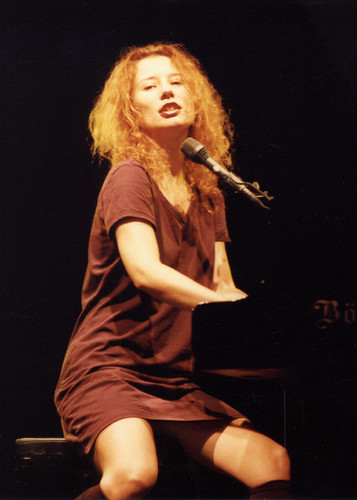
Nowhere is this clearer than on Kristin Hersh's ferally brilliant album Murder, Misery and Then Goodnight, which brings new life to old songs by revoicing them -- not from a female perspective, but as a female singer, in an act of transgendering. Rather than rewrite the lyrics to give us female murderers (there are a few of them in the old ballads as well), or happy endings (the Disney post-feminist princess trick), Hersh - like Gilmore with JWH - stakes a claim to the songs and the masculine archetypes they contain. Hersh's jangling take on classic American folk songs (including lullabies with dark intentions) preceded, by three years, Tori Amos' better known project Strange Little Girls, a cover album that identified female personae within and as narrators for songs by male artists, playing with goddesses and (as this Red Riding Hood-inflected video shows) fairy tale heroines.


But unlike Disney re-ups, Amos' strange little girls -- with their wigs and wolves and vaginas raining blood from the sky -- show that femininity is a performance, a put-on (or stick-up), a costume: one that is often worn under duress, or interpreted as putting oneself at risk. Stranger still, Dylan's JWH ends with a song that might suggest the same about masculinity. "I'll Be Your Baby Tonight" -- if you look at the title objectively, what it offers is a position of vulnerability: not I'll be your lover or man or master, but "baby." Yes, it's also a little creepy. But the nursery rhyme-like lyrics ("The big old moon's gonna shine like a spoon" -- what do you make of that little gem, Ricksy-baby?) and suggestion of escape and the abandonment of social norms and the outside world - close the door, kick your shoes off - creates a space beyond gendered identities (OK, so the singer is pretty bossy and demanding -- "bring that bottle over here" -- or maybe just wants to go the whole baby fetish...), a space where men can admit to vulnerability. And sung by a pregnant Thea it has something extra, some enlargement of the aspects of human life that tend to appear in pop music. Open your eyes, open your door, maybe?

Wednesday, May 18, 2011

Singing the Pirate's Gospel

...which is what I have been doing for the last week, since seeing Alela Diane at the Scala. I am an Alela nerd (yes, limited edition vinyls, SXSW sessions, semi-legal download of her unreleased first album; even an Alela-hand-made quilted T-shirt) but her new full-band project Wild Divine leaves me... hmmm. Part of it is that I think it would be weird to go on tour with your dad and your husband, but I have neither so who am I to say. And part of it is that the swinging 70s rock-out sound is not one that means much to me, compared with a girl and her guitar. Especially coming on after the support act -- a wildly brilliant, triple-drumming Peggy Sue, who played a kicking set while dressed in homage to John Hughes' movies that they are TOO YOUNG to have seen first time round, which was adorable/made me feel ancient -- the whole Fleetwood shtick felt old to me.

Which is maybe its point: homage, retro, etc. So why was it not as adorable to me as Peggy Sue's drummer rocking an Eric Stolz fedora? It's not like I love the 80s in any way. Alela, incidentally, was wearing a low-backed, knee-length fringed black dress. Her all-male band were in jeans. And there, for me, is the bind: that 70s sound is, well, kinda floozy. Maybe then it was in a good way, but now it seems to part of the flow of the sexualisation of women in the music industry rather than a protest against it. And here's the double bind: while Alela absolutely has the Lady of the Canyon voice to sell the songs, even over the great wash of guitar and bass that her producers have thumped her with (the bonus CD showcases the pre-wall of sound versions which grab me much more), but she can't channel Stevie Nicks via her hips.

And nor should she have to -- or feel she has to. But somehow that sound demands a performance of free love female sexuality. Which brought home to me just how far our perception of female performers in the music industry depends on how they perform with their bodies -- not just Rihanna and Xtina and etc., but ALL female performers. If they're folky, they're expected to be coy, virginal, or medieval: it's not just a beard/no-beard or plaid/no-plaid deal as it is for male performers, but about the interaction of the triad of their voices, their bodies and their accessories. And while many reams have been written on the agential performativity of sexuality by Madonna (etc., etc.) and, conversely, the sexualisation of male performers (differently) in hip hop and boy bands, I feel that it skirts the issue.

So I'm particularly excited by Peggy Sue and their keening monotone, which is full of desire and rage and anomie, and is queer without being Song of the Week on Glee. And also about seeing PJ Harvey later this summer, because Let England Shake doesn't just raise the envelope or push the bar or dance circles round the box of female performers' sexuality, it just walks straight past. Having screamed her desire for her ex-lover's "fucking ass" on A Woman A Man Walked By, perhaps she feels she's gone as far as she can with the straight-talking, SlutWalking style she pioneered. And it's not that the historical/geological palette of Let England Shake is _better_ than her unquestionably feminist and intensely exciting previous material, but that she's found a way to do something _different_ (following in the barefoot thoughtsteps of Patti Smith's Trampin' in some ways). Let England Shake's sense of the bodily as earthly/earthly as bodily -- in this case applied to mapping the traces of wars 'abroad' in England's landscape -- first appeared on White Chalk, where the wars were within a woman's body. The albums, for me, are a pair, and I'm intrigued to see how she'll follow up her White Chalk show which I saw at the Royal Festival Hall: Edwardian gown; toy instruments; soft-voiced, inter-song banter. How will she make Alexandra Park shake?

This all matters to me not only because pop music is a huge tranche of dominant culture and socialisation, but also because poetry, for me, is -- very deeply, almost unacknowledged -- a substitution or sublimation of my primary desire to be a singer-songwriter. Blame/congratulate my early exposure to Joni Mitchell and Carole King via my mum's own Lady of the Canyon period. Or my surprise encounter with Tori Amos pre-Little Earthquakes (and I'm very excited about the new Tori album AND about a Tori poetry tribute I'm going to be involved in this summer). Or discovering Tracy Chapman just when I needed her most. Or being arrested, breathless, by the video for Kristin Hersh's Your Ghost on MTV. Or even blame my parents for my Hebrew name, which means little bird. I've always wanted to sing but I'm beyond unmusical.

So poetry it is, but always in relation to that (r)evolving group of female musicians who dominate my stereo/iPod. Hence the question of performance and sexuality feels very personal: what to wear to a reading, which poems to choose (rude or not rude), how to banter/flirt -- all with the aim of "selling", which is itself, of course, highly sexualised, especially for women who are still perceived as selling themselves (ie: their sexuality; ie: the only thing they have -- although don't own) whenever they appear publicly. Which makes all the choices non-choices: Victorian nightie? Basque and chaps? Meat dress? It's always a complicitous critique because it engages in the discourse set up by patriarchy in which a woman is defined by what she wears, and is thus always defined as sexually available by dint of wearing clothes, as all clothing either reveals or conceals the body and can thus be interpreted as sexualised. This is what the SlutWalk is all about. And I am all for it.

But I feel like, rather than wanting/needing to wear a short skirt and clumpy boots (I spent my 20s doing just that, and it was great, actually), I need the outfit equivalent of Trampin' or Let England Shake: a performativity that doesn't even get into the argument, that says something different on its own terms. Any suggestions?

Friday, May 13, 2011

For Joanna Russ, imaginaire extraordinare


Little Endless Delirium with some of the Women's Press Science Fiction to be found in Delirium's Library (well, all that could be found: the rest has been put somewhere Very Important and Easy to Locate that I now can't remember - hence the name of the library) including Joanna Russ' The Female Man and The Hidden Side of the Moon.

Feminist science fiction pioneer Joanna Russ has died, aged 74, on 29 April after a series of strokes. Christopher Priest's obituary for The Guardian does an excellent job of explaining why her work was so important (and unjustly neglected), but it doesn't describe the impact of reading it: while Eleanor Arnason writes that she found Russ' work abrasively angry, she also notes that thinking about Russ moves her to want to write more.

As much as the sexual anarchy and political energy of Russ' work, it is this will to write - to share stories, to reinvent them - that I take from her work. Her humour, her generosity to her characters (who tend to reappear from short story to novel), her critical thinking about writing, are embodied in her appetite in later life (according to Priest) for slash fiction, which derives part of its charge from busting open canonical texts, and part from doing so in a supportive, reciprocal community. In her introduction to Chinks in the World Machine, Sarah Lefanu notes that many feminist SF writers began by writing slash or (earlier) novelisations of TV episodes. That idea of fiction as a communal practice, as a shared art, a conversation -- and refuting the denigration of such an idea within capitalist patriarchy with its demands for the Author and [his] Originality -- is central to both Russ' embrace of science fiction as a recyclic genre, and to her witty (and yes, purposively angry) critical writing.

In reworking, she salvages and surfaces the unpredictable: not just untold stories, but untellings.
When Janet Evason returned to the New Forest and the experimenters at the Pole Station were laughing their heads of (for it was not a dream) I sat in a cocktail party in mid-Manhattan. I had just changed into a man, me, Joanna. I mean a female man, of course; my body and soul were exactly the same.
So there's me also.
While Joanna [Russ] has died, Joanna (and her parallel selves Jeannine, Janet and Jael) show us possibilities for who we can all be, also.

Saturday, March 19, 2011

"With his kiss the riot starts": What Hades Has to Say about Poetry

Anaïs Mitchell's Hadestown has been on my mind (and in my ears) constantly for the last few days. When it came out last year, I was struck by its ambition (the story of Orpheus and Eurydice retold as a modern folk-pop-blues opera) and its reconfiguring of lyric, ie: songs of love, of which Orpheus is the mythic father. The economic, political and affective complexities of the male poet hymning (always-already lost) love are laid bare through the subtle shift of the story into multiple perspectives, including Eurydice's.But relistening to it in the last weeks, what has come to the fore is its political observations, which seen incredibly timely -- Orpheus the folk poet-hero of a revolution against a tyrant who has imprisoned his songbird (who stands for freedom).

Reviewing the London performance of the opera at Union Chapel for the Independent on Sunday, Simmy Richman concludes:
At the show's centre is a song so sensational that even the discomfort of our hardwood pews is forgotten. "Why We Build the Wall" is both the story of life in the mythical underworld and as potent a parable as it is possible to write. "Why do we build the wall?/We build the wall to keep us free/And the wall keeps out our enemy/What do we have that they should want?/We have a wall to work upon/We have work and they have none/That's why we build the wall."
When I read the review in January I was more compelled/intrigued by the start, where Richman admits that "finding out about the best album of 2010 a few weeks after compiling your end-of-the-year list is about as grave a mistake as it is possible to make if you review music for a living," which made me think cynically about the multiple ways in which the UK music press ignores a class of female singer-songwriters whose work is not "freak" enough to fit their hipster folk tastes, or poppy/pappy enough to be patronised.

But it's the wall that I have come back to, and to the character of Hades, "king of the kingdom of dirt," "a mean old boss / With a silver whistle and a golden scale," sung on the album by Greg Brown, with a thrilling depth and steeliness. Hades only has one solo, "His Kiss, The Riot," where he lays his plans to trap Orpheus in the mythical double-bind of the terrible "don't look back." "Nothing makes a man so bold / As a woman's smile and a hand to hold / But all alone his blood runs thin / And doubt comes in, doubt comes in" he concludes, leading into Orpheus' and Eurydice's duet "Doubt Comes In." Though he uses it cruelly, Hades knows his psychology: he knows Orpheus, like all of us, is susceptible to fear (as is Hades himself), just as he knows -- and uses -- Eurydice's fear of poverty in "Songbird," when he seduces her to stay in the Underworld.

In "His Kiss, The Riot," Mitchell offers a fascinating insight into the psychology of dominance: her reading of Hades makes it clear that tyrants are not enormities, bizarre distortions of human nature, exceptions to the rule, aberrant perversions or magicians who put whole populations under a dangerous spell. They are human and -- under capitalism, with its structuring metaphor of competition -- they are inevitable. Hades speaks the language of spin, with its niggling, irritating grain of truth under layers of nacreous polish, when he says that "All my children came here poor / Clamoring for bed and board," arguing that he offered the miners, gravediggers, and -- in that spectacular image of the futility of capitalism and empire -- wall-builders work to raise them out of poverty (while of course, as Persephone's seductive "Our Lady of the Underground" hymns, keeping them in poverty by selling them illusions to buy with company scrip). "Now what do they clamor for? / Freedom! Freedom!" Hades protests, the music dropping away behind his barks of "Freedom!," as if there were no music that could support such a word. For him, it is the disruptor of harmony, of his perfect, closed system.

In Hades' cry, we can hear Ben Ali, Mubarak, Gaddafi, the House of Saud -- but also every politician and manager who believes in the system. But the song also suggests just how vulnerable the system is, if it can be brought down by a kiss (or the image of a suicide, or a cardboard sign, or a line of poetry), and how insecure every tyrant, every person of power, is concomitantly. Power's main belief in itself is in its unshakeable stability: if it's not perpetual, it's not power. But Hades is "stricken… stung" by Orpheus' song -- so stricken that, after this cruel unfolding of his well-laid plan, his voice is not heard again. Orpheus falls away, as Hades predicts, and it is Eurydice and Persephone who end the opera, mourning and remembering him.

Hades is troubled by Orpheus because his devotion to love suggests that there is another way of life, one that is potent and provocative: "With his kiss the riot starts." That kiss awakens not only love, but love's insurgence, its refusal of ownership and hierarchy, its need rather than want, its poetry of productlessness, the very qualities that Hades puts forward so snidely when seducing Eurydice:
Hey little songbird, let me guess
He's some kind of poet - and he's penniless
Give him your hand, he'll give you his hand-to-mouth
He'll write you a poem when the power's out
Again, there's that irritating grain of truth: Orpheus is a dreamer, offering to get the river, trees and birds to arrange a marriage; the fear of poverty and hunger is real. But Hades, with his clever lines (as the Devil gets the best tunes, so Hades gets the cleverest turns of phrase, which in itself becomes a kind of cheapening of the poetic power of language), presents the symptoms (poverty, hunger) as the disease. Orpheus isn't poor because poverty is the natural state of poets, but because the society Hades runs doesn't value their labour -- and demands that they pay for the necessities of life.

But Hades' words are persuasive: "Hey, Little Songbird" is not a solo, but a duet, as are "Why We Build the Wall" (with the Hadestown Chorus) and "How Long" (with Persephone). Hades' system works because others are complicit in it: his workers and his wife. But complicit is a complicated word: Hades and his lifestyle are powerfully charismatic. "Seems like he owns everything / Kind of makes you wonder how it feels," Eurydice sings. And there Mitchell pins the biggest problem of power, which is that it itself is seductive. Rather than protesting, dismantling or exiting the system, the Workers and Eurydice want to use it, to become like Hades; to shelter in his power and thus to have it. Orpheus, compelled by his love of Eurydice, needs and offers something different - an outside, an unravelling of the whole system.

But Hades identifies that Orpheus, too, thrives on power of a kind: "Bravery can be contagious / When the band is playing loud." As well as the touch of a woman's hand, Orpheus -- as a poet -- depends on his audience and his culture for support. He needs to be heard, he needs to be approved, to move, to connect. And so he is vulnerable to the machinations of power that would separate him from that audience (and this is the springboard for much of the work of PEN, like this event for Chinese Nobel Laureate Liu Xiaobo tomorrow night). And this raises a profound question for me about vulnerability, one that has been mulling since I read Judith Butler's Frames of War.

That question is about how to sustain vulnerability when it is exploitable by power - but is also, Butler concludes (in alignment with Gandhi), the most durable form of resistance to power's depredations. I don't know how -- but Tahrir Square seemed to me to offer a model. My friend Rebecca passed on a translation of a sign she had seen there: "I was afraid -- and I became an Egyptian." Rather than repressing fear, as power does, or buying goods to cover it up, as power exhorts us to do, the protestors walked into, and with, their fear as a shared expression of being human. Not just "I was afraid," as Orpheus finds at the end of the song, but "and I became an Egyptian." Rather than putting the author out front in a combat for hearts and minds, or in conflict with his forefathers, or trying to win his crust, is there a poetry that can sing this shared consciousness?

Butler thinks that this is exactly what poetry (and only poetry/song, freed from the cause-effect constraints of narrative), removed from the marketplace, can do. She says: ‎
When the Pentagon offered its rationale for the censorship [of poetry by Guantánamo detainees], it claimed that poetry 'presents a special risk' to national security because of its 'content and format'… Could it really be that the syntax or form of a poem is perceived as a threat to the security of a nation?
and concludes that its not the syntax of form of the poem that's a threat, but its relation to the body and its relation of vulnerability. Even Hades, when he sings, sings of emotions -- song itself breathes with and from affect. Orpheus, who is all poem and no body (as the end of the classical myth recognises), finds himself overwhelmed by doubt -- that is, a belief in his own isolation -- and loses Eurydice, who asks him to "hold on tight."

Hadestown agrees with Butler, that interdependence and vulnerability (Butler calls it injurability) are inextricably linked and are definitional of life; they also agree that poetry is the form for voicing this injurability. But poetry also needs to "hold on tight", not to the sound of the band or the praise of the crowd, not to its reflexive, hyper-critical sense of itself as poetry, but to its relations with life, the body and freedom. It needs to feed us more than rivers and trees. It needs to "hold on" to its connection to us all -- and so it needs to have an informed comeback to Hades' clever lines and cutting insights in order to keep language vital. This is another way of saying that poetry is always political, that the lyric cannot shut its eyes against that busie old fool the sun and the world it brings in.

Hadestown shows this subtly: in between "How Long," Hades' duet with Persephone where he argues that "nothing comes of the songs people sing / However sorry they are" and the collapse of his wall in "His Kiss, the Riot," comes Orpheus' solo, a reprise of his earlier song "Epic," which is a description of Hades and his world. Envisioning Persephone "in her mother's garden" he sings that "suddenly Hades was only a man / With a taste of nectar on his lips." Love undoes even Hades. But it's not just the lyrics, which contrast the man of steel with the woman of flowers and pollen; the song is followed by an instrumental "Lover's Desire," a traditional Afghani piece. Persephone's image is at once Greek and part of the tradition of ghazals and shash maqam, the musical styles of Persia and Central Asia. And she is married, inextricably (if seasonally) to Hades: by kidnapping her, he has connected himself to her forever. Interdependence begins in vulnerability -- but acts of violence cannot destroy it, only secure the bonds tighter. That allows, just maybe, for that vulnerability, for the party that has remained vulnerable, to begin -- amplified by poetry, perhaps -- to effect change, to destabilise the violator. Just maybe.

You can see why the Pentagon banned those poems. Hades does the same.

Saturday, March 12, 2011

Peace News from 2011/1966


American Eagle beating its wings over Asia
million dollar helicopters
a billion dollars worth of Marines
who loved Aunt Betty
Drawn from the shores and farms shaking
from high schools to the landing barge
blowing the air through their cheeks with fear
in Life on Television
Put it this way on the radio,
Put it this way in television language
Use the words
language, language;
"a bad guess"

Found in Oxfam Books and Music.
Published in 1966 by Peace News, still resisting war and violence from Caledonian Road, N1.

Wednesday, February 09, 2011

A Frayed Knot: Unpicking Susan Hiller @ Tate Britain

My earliest memory is of a dream. It was the house where we lived when I was three or four years of age. I dreamed I was asleep in the house in the upper room. That I awoke and came downstairs and stood in the living room, although it was hushed and empty. The usual dark green sofa and chairs stood along the usual pale green walls. it was the same old living room as ever, I knew it well, nothing was out of place. And yet it was utterly, certainly, different. Inside its usual appearance the living room was as changed as if it had gone mad. (Anne Carson, 'Every Exit is an Entrance (A Praise of Sleep)', Decreation, 19-20)

Walking around Susan Hiller's retrospective at Tate Britain is like walking around the living room in Anne Carson's dream. Here are the familiar materials of contemporary art: for the film installations, projectors and speakers and benches and headphones arranged in small dark rooms down narrow, dark, baffled corridors; for the rest, hyper-realist photographic reproductions and scientific diagrams and found objects and automatic writing and text panels and vitrines and series and repetitions.

And in the middle of it all, "The Writing on the Wall," a living room with a dark sofa and chairs and a television on which a video of a flickering fire plays. Softly lit in amber, this is a womb-like space. Comforting -- except for the haunting singing and child's voice and readings from distressing news stories playing almost inaudibly from speakers. Think Sarah Palmer moaning on the floor of her living room in Twin Peaks. I sat there with my co-conspirator in all things art for ages; we hugged cushions to our bellies and told stories of disturbed nights, possessed bedrooms and all things unhomely until we freaked ourselves into freezing cold.

It is in this territory of the embodied uncanny -- the gesture, object, ritual, sound just slightly out of place so that it shows the whole system is skewed -- that Hiller works. She is best known for "From the Freud Museum," an installation of vitrines containing Cornell-like boxes (except far more organised, their apparent rationality and decorum underlining their intuitive and disturbing associative illogic) that respond to objects owned by Freud and displayed in his museum in Hampstead. Although it's in Tate Modern's permanent collection, it is exhibited here in a new arrangement.

To get a sense of the variety and precision of her practice, as well as her assiduous engagement with verbal language as part of the texture of visual art, here is a list of the words Hiller uses to describe the composition of each individual box in "From the Freud Museum":
annotated, edited, collected, portrayed, collated, addressed, curated, indexed, extracted, displaced, realised, navigated, filed, diverted, presented, witnessed, classified, explored, represented, designed, compiled, assembled, positioned, practiced, surveyed, manifested, preserved, researched, acquired, included, remaindered, clarified, validated, labelled, processed, registered, analysed, organised, sampled, found, boxed, rated, bound, fitted, located, acquired, extracted, finalised, displayed, situated.
To which I could add, in terms of the effect on the viewer, stimulated, invigorated, dizzied, nauseated, disturbed, and slightly obsessed.

This is the sixth time I've seen "From the Freud Museum" and the second time I've seen a Hiller retrospective, which adds to the uncanny feeling of furniture just out of place. At the Baltic in 2004, "Witness" (a forest of speakers relaying stories of alien abduction) was installed in a bright, white high-ceilinged room that referred architecturally to the minimalist spaceships of our cultural imaginary. At Tate, the piece is installed in a smaller, darkened room with a round light in the centre: we are on earth, at night, perhaps on a highway where the streetlights have failed, and the spaceship is hovering above us. Claustrophobic and distinctly creepy, it was less moving than the Baltic installation, but also less clinical -- more uncanny, as I felt less an identification with the speakers, and more their urgency requiring that I believe.

Also in the dark are the video installations "An Entertainment," a Punch-and-Judy show I find too disturbing to watch (especially to the embarrassed accompaniment of undergrad art student high-pitched giggles), "Magic Lantern," an experiment in etheric voices and optical illusions that is at once blissful and disturbing, and "PSI Girls," a cultural history of telekinetic female film characters that moves from the joyous and chaotic energy of the pre-pubescent Matilda to the violently phallic, attenuated adolescent focus of Sarah Bailey (Robin Tunney) in The Craft.


But the most striking piece was one I hadn't seen/heard before -- the equivalent of that dream where you discover an impossible room in your house (as in The Eleventh Hour in the most recent season of Doctor Who, or the impossible extra spaces in House of Leaves or Coraline). "The Last Silent Movie" (2007) is described in the accompanying text panel as neither silent, nor a movie. Although it is a video and audio installation, I thought it was closer to 'Sisters of Menon,' Hiller's experiment in automatic writing, in the notes to which she writes that
MESSAGES SUPPRESSED BY THE SELF DO NOT CEASE TO EXIST. MESSAGES SUPPRESSED BY THE CULTURE DO NOT CEASE TO EXIST.
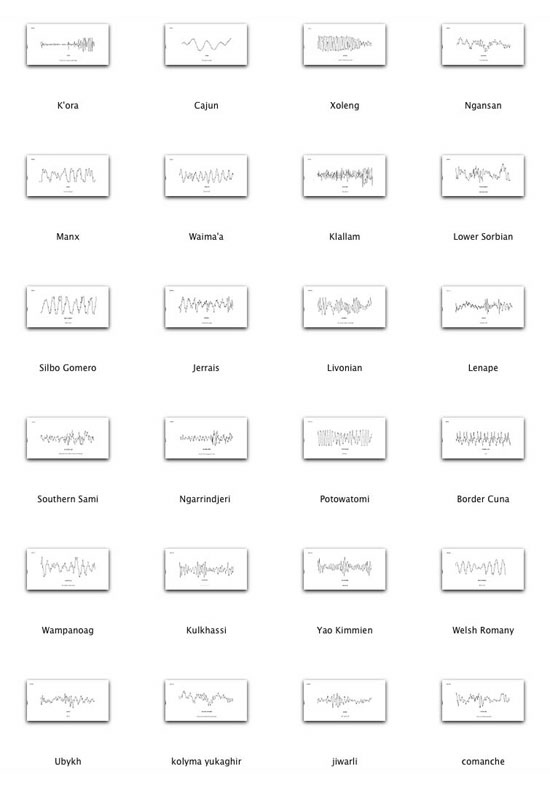
'The Last Silent Movie' recuperates suppressed messages: specifically, archival recordings of last or late speakers of two dozen languages worldwide. These messages are represented by an audio track, a video of white-on-black subtitles translating the recordings into English and naming the languages, and framed oscilloscope traces of the recordings, accompanied by striking phrases translated into English. (You can see and hear samples here.)

Perhaps the most striking phrase is an unbearably sad annotation that appears in the subtitles and on the oscilloscope reading for Kulkhasi, a language no longer spoken in South Africa.
Her language is extinct and her song cannot be translated.
The film offers up an inverse Rosetta stone, a record of languages eradicated by colonialism and globalisation even as we apparently enter a golden age of communication technology. The recordings are at once amazing and salvific and, made by Euro-Western anthropologists and at academic conferences, a trail of destruction, of information without understanding. Hiller is an anthropologist by training, which sharpens the installation's critique, the despairing EuroWestern fantasies of both erasure and recovery at the white man's hand balanced by a respectful sorrow towards necessary strategies of silence:
We learned to hide our language and our secrets
states the oscilloscope from Jiwarli, a language from Western Australia.

It is these oscilloscopes that most closely fulfil Hiller's declaration 30 years' previously in month seven of '10 Months' that 'There is no distinction between "reading" images and reading texts.' This is the third in the month's list of 'Knots and Knows, Some NOT's and NO's about art.' For Hiller, the k/not of signification is negative insofar as it is fixed, positive insofar as it is always available to be undone and rebraided. The first large work in the exhibition, the remains of a performance called 'Work in Progress' (1980) make this plain: over the course of a weekend, Hiller unwove the canvas of one of her abstract paintings into its constituent threads, which she wound into a ball, strung across the wall (in homage to Duchamp's Witch's Cradle, or Deren's deeply uncanny film thereof?), and plaited into a thick braid which is attached to the wall at the Tate with silver nails.

Witchlocked, the tail of a night mare, a fetish, a Victorian love charm, a female craft (the only female invention, according to Freud), a model of human interconnection, a quipu, a Surrealist crucifixion: the braid knots together the sources of Hiller's work across myth, occult, antiquity, anthropology, craft, modernism, deconstruction, and embodiment. In its simplicity and its visual arrest, it sums up my reaction to her work: a frayed.

Wednesday, January 26, 2011

Squint Your Eyes and Look Closer, I'm Not Between You and Your Ambition

© Natalie Harrower, 2011.

Some weeks it's good to be a(n ageing) riot grrrl (woo grrrl, did this article from Friday's Guardian with "20 years ago" in the headline make me super-aware of my growing Sontag). But I'm not alone in growing old disgracefully and ever more riotously (can you be a riot wrrrrmrrrrn?). Carrie Brownstein, Sleater-Kinney badass, is writing a TV comedy series called Portlandia for IFC, which includes the (so, so untrue ;) Feminist Bookstore sketches (early versions can be seen at ThunderAnt). PJ Harvey has a growly-melodic wild new album (the aptly named Let England Shake) out soon, and Patti Smith said in an interview that she's been
listening to Polly Harvey's new song – she has this new song, The Words That Maketh Murder – what a great song. It just makes me happy to exist.
And, oh yes, this Saturday I went to see Ani Difranco in play a solo set in Dublin with my friend Natalie and a group of women from Running Amach.

Natalie and I worked out that we'd been to at least three of the same Ani gigs before we even knew each other -- bound by the solidarity of queer/feminist independent music (the Righteous Babe pose is pretty much the secret handshake you always wondered if queer women had to find each other ;). We also worked out that this was the best gig we'd seen for years: the most energised, inventive, alive and well, rioting. There were a couple of new songs -- Amendment and Promiscuity -- that offered complex, narrative analyses of politics and people as they entwine (the set list we reconstructed is here -- and more photos here, by Rosa Paolicelli).

Ani gigs, being a rare constant in a blurry, confusing life, often make me remember previous Ani gigs: the first one I saw (after winning tickets from DIVA!) in Shepherd's Bush in 1997, when she played "Swan Dive" and I instantly gave my heart to her (for some reason, I love songs where the female singer uses the word "tampon" -- blame riot grrrl). Or the first gig I saw in Canada, in the gym at the University of Guelph, two hours after being dumped; riding home on Coach Canada through the flattest flat fields in the world, listening to "Providence" and crying. Happy times. Whooping with a crowd the size of Lake Ontario outdoors at Fort York when she sang "To the Teeth," ending "I'm gonna take all my friends / Move to Canada / And die of old age" as the lights flared pink against the summer twilight. It was during Ani's set at the Cambridge Folk Festival in 2000 that I decided, for definite, to get my first tattoo; decided what it would be and where it would go. "Five foot two, wriggly and giggly," it feels sometimes like she's a livelier, brighter, more musical, more passionate (and more tattooed, although only just) version of me, leading the way out there.

Because -- confession -- long before I ever wanted to be a poet, I wanted (needed?) to be a singer. Raised on Joni and Carole by my child-of-the-sixties mother, I grew my hair long and wrote lyrics (boxes and boxes full o' lyrics) on my grandmother's old Olivetti typewriter, bashing away in my room to silence out everything else. Sadly, musical talent passed me by, and I couldn't master those teeny keyboards you got in going-home bags let alone a full-scale instrument (despite my passion for Jacqueline du Pré). So instead I committed the lyrics of Little Earthquakes to memory (and analysed them for months in my diary). And how excited am I about Tori bringing a musical to the National Theatre next year? Already saving money for a sleeping bag to camp out for tickets. Second confession: I know it's much cooler to be a riot grrrl, to worship at the altar of Patti Smith and PJ Harvey (and I do). But the wellspring of my poetry is a response to the more lyrical, more trebly, more folky, more (gulp) girly vocals and versification of Tori and Ani.

This blog post honestly feels like a form of coming out. The critical consensus on cultural cool is such that there is a canon of alt.rock acceptable to cite in poetry, or even describe as poetry - Bob Dylan, Leonard Cohen, Joy Division, maybe the Pixies. Patti Smith seems to have made it there since Trampin'; Paul Muldoon has a PJ Harvey poem. (Everyone has a Dylan poem.) But those flauntingly emotive, excoriatingly intimate, musically brilliant female singers? Not a chance (although Ruth Padel has a poem about Tori Amos' Bosendorfer piano). They don't really do irony. They don't really rawk. Their voices are high in the mix, their lyrics treble and tremble with confession and the contortions of conscience. They are about tampons and goddesses and mothers and abortions and not being a pretty girl. But still being a girl. If that's even possible. They want to know who you are.

They sing straight out to the audience, to you in the audience, to you at home in your room with your Walkman on trying really hard not to hear anything beyond the headphones. They say "excuse me, but can I be you for a while" and demand that you be present, you be really there. In poetry, the invocation of 'you' is called apostrophe, and Jonathan Culler argues that apostrophic address (‘O beloved as thou art! // O lift me from the grass!’ from Shelley's 'An Indian Girl's Love Song') is almost absent from contemporary poetry because it exemplifies ‘all that is most radical, embarrassing, pretentious, and mystificatory’ about the act of writing poetry -- of addressing intimate thoughts and visions to an assumed, absent audience. It's scary stuff. It means opening yourself up.

So if loving Ani and Tori is embarrassing and pretentious, which I can sometimes feel in hipster poetic company where I don't get every Dylan reference, then it's also radical and mystificatory because of its vulnerability, its openness to the possibility of being undone. Not a bruised, wounded drawl but tears. But the tattoo of a wedding ring. Something previously unheard and singing.

Saturday, January 15, 2011

Holiday Reading, or Order vs. Chaos

…in which I continue with the questions asked in the previous post about the randomness/associatedness of any given stack of books. Given that no selection is entirely random (not least because I bought or borrowed all the books and so my taste is a major associative principle), but also that some associations are unpredictably weird (both Jenny Diski and Margaret Atwood cite Franz de Waal's study of brown capuchin monkeys and their cucumber/grape value system -- zeitgeist?) I am also curious about why some books satisfied and others irritated, particularly relating to ideas of order and chaos.

So, the books read were (in order, as far as I can remember):
Samuel Delany, The Einstein Intersection (thanks to Theo Chiotis for the recommendation)
Sylvia Townsend Warner, Summer Will Show
Neal Stephenson, Anathem
Jenny Diski, What I Don't Know About Animals
Doris Lessing, Shikasta
Ariel Dorfman, Other Septembers, Many Americas: Selected Provocations
Marilynne Robinson, Housekeeping
Frances Presley, Lines of Sight
Giles Tremlett, Ghosts of Spain
Margaret Atwood, Payback
Patti Smith, Just Kids

One obvious connection/division arises instantly: science fiction and non-fiction. Pleasure/work? Or work/pleasure (or cucumber/grape, in the de Wall duality) (to risk echoing those irritating HSBC ads that accompany the journey into hell/the Ryanair boarding system). The books I was most excited to read were Anathem and Just Kids, having waited for all 1000 pages of the former to appear in paperback. I made a seemingly random decision (based on Ryanair's draconian cabin baggage policy and the capacity of my coat pockets) to begin my reading orgy with the relatively slim Delany -- and this may have been a strategic error. After Delany, most other SF seems laboured, laborious and portentous -- some would say that Stephenson and Lessing, both wordy authors with a love of didactic world-building, are prone to those faults even without comparison to Delany.

Einstein Intersection, from its euphonious title to its limpidly beautiful conclusion, might be a tenth of the size of Dhalgren, but is packed with similar ideas about travel, cyclicity, community, desire, curiosity, urbanity, and entropy. Its final lines are indicative of its ambiguous and generous nature: "As morning branded the sea, darkness fell away at the far side of the beach. I turned to follow it." I love that idea that turning towards the dawn is also following darkness.

Alas, none of Stephenson's atomic explosions could compare to that sunrise. Sylvia Townsend Warner's historical lesbian romance, set during the Paris Commune and told though the cycle of seasons and sunlight (as the title suggests), fared better in the inevitable comparison stakes: absorbing, witty, prickly, intelligent. It also shared with Delany's novel what's conventionally called an "open ending"; that is, that the final paragraph finds the protagonist setting out on a new adventure after failing to complete the quest that has taken up the course of the book. In each case, the protagonist spends the bulk of the novel striving for the love of a particular woman, and ends by losing that love to death. Lobey, Delany's Orphic protagonist, learns through an encounter with Le Dove (a Persephone figure) that he can change the myth, and journey rather than grieve -- an exciting conclusion that suggests change is possible.

Likewise in Summer Will Show. The majestic, infuriating Sophia Willoughby stays in the apartment of her dead lover, revolutionary Minna Lemuel (formerly her husband's mistress), rather than return to the living death of her Aunt Léocadie's patrician circle. She too starts on a journey, one that begins: 'A spectre is haunting Europe—the spectre of Communism.' Sophia ends the novel 'obdurately attentive and by degrees absorbed' by the Communist Manifesto. A highly dangerous text when Warner was writing in 1936, the Manifesto wrenches open not only the end of the novel but the very idea of the fictional narrative as having an ending -- and thus the relationship between writing "The End" on the final page of a novel, and the changeable nature of living history.

The Einstein Intersection was composed as Delany travelled around Mediterranean Europe, and shares with Summer Will Show a restless engagement, by rewriting, with European mythic history. Shikasta likewise grapples with myths, or rather with Myth, taking on Genesis and Exodus, explained as a Chinese Whispered account of the enlightened beings of Canopus colonising Earth (known in its latter days as Shikasta, the Broken). I initially pinned the novel as satirical, a dark comedy about the dangers and hypocrisies paternalistic imperialism, and I think that reading stands (why else write a novel that consists primarily of reports by alien/angelic functionaries, alternating in the latter stages with the diary of a character who is sacrificed to their 'higher' ends?) but there is a deadly (as in deadening) moral seriousness that accompanies it. The ending of the novel seems "open" -- in that it posits the rebuilding of Earth according to Canopean principles, and in that the book is the first of a sequence -- but in fact slams closed. The rebuilding of towns by a United Colours of Benetton assortment of well-intentioned characters is a nostalgic return to Edenic first principles bathed in the Canopean glow of SOWF, sense-of-we-feeling.

Anathem ends with a similar scene of communitarian rebuilding that is in fact a repetition of patterns sealed by a novel obsessed with geometry and things carved in stone; it doesn't mention Neolithic stone circles as Lessing does, but they appear in Frances Presley's Lines of Sight: not as Canopean symbols of cosmic alignment, but with their mystery intact. Stephenson, a mathematical whiz, loves a neat equation: whether algebraic, geometric or narrative, he likes his sums to come out right. For me, this makes his novels zero-sum games, which is after all the conventional structure: the story begins with order; chaos comes; order -- a slightly better, more thoughtful/wealthier/more pair-bonded order -- is restored, better protected against the coming of chaos. And they all live happily ever after.

In fact, Stephenson's novel is about the orderliness of order: it posits alien beings from other versions of our cosmos who (apart from a slight different in nostril shape) look just like us! How convenient, one might suggest, to erase in one stroke the metaphor of the alien as racial/sexual Other. These other humanoid beings have dyadic sex/gender, innate drives towards progress and violence, and (of course) Euclidean geometry. Orolo, the novel's expositionary character (in a novel that is 90% exposition, Orolo's use as the Basil stands out), leads the protagonist Erasmas in a "dialog" (the technical term given to Anathem's version of Socratic discourse) towards the realisation that this means that the bipedal, bilateral, heterosexual human form and attendant "human nature" are the closest to the ideal form (ie: Platonic) and therefore the best of all possible outcomes tended to across the polycosmi. This inclines Erasmas and the people of his version of the cosmos to welcome and collaborate with the incomers after scaring the bejayzus out of their leaders with a vision of the handily-named Everything Killers.

Sense-of-we-feeling, the notion that we are all the same under the skin, has been a valuable tool for peace-making and post-war reconstruction work, as well as for civil rights and human rights movements, and Lessing's impassioned denunciations of racism and sexism (as well as the amazing feat, at least in the edition I read, of featuring a character of colour on the cover of a science fiction novel -- something Ursula K. Le Guin has written about in relation to the continued whitewashing of Earthsea) are to be respected rather more than Stephenson's supposedly gender- and race- blind writing in which all the main active roles fall to white males. This is a problem with SOWF: that it inclines towards the sense that everyone is like us, where "us" means a dominant culture, handily allowing the representative figures of that culture to carry on carrying on, because they are now representative of everyone.


This is something that Jenny Diski and Giles Tremlett both touch on in their approaches to two very different dyads: human/animal and the two Spains (generally interpreted as Left and Right, but also expandable to nationalist/federalist-separatist; Christian/non-Christian; urban/rural; Barcelona/Madrid; men/women, and other variations that don't quite fall into line along left/right divisions). Diski is brilliantly insistent on the absolute Otherness of animals and the uneasiness that creates for humans as cultivators and companions (it also gives her an excuse to repeat the phrase "Derrida's pussy", which I found funny every time). She writes incisively about attempts to make animals like us (ie: to include them in SOWF), most wittily in her reading of LOLCat and the LOLCat Bible, which does a much more convincing job of revealing the strangeness of Genesis -- and the way that Genesis tries to harmonise the strangeness of existence -- than Lessing does in her systematic account of Canopean contact.

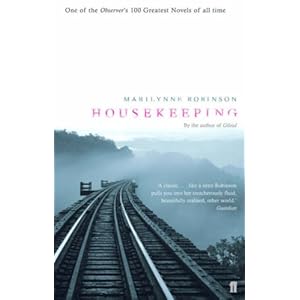
Rather than chaos, with its negative religious associations, maybe I should make the other term in my dyad strangeness. Although Housekeeping is, in its enchanting way, a hymn exactly to chaos: to the entropic, to letting go, to stepping outside order. The chaotic is a principle of strangeness, of the interruption of a system by something outside it, something with its own kind of order, like aunt Sylvie in Robinson's novel, who lets leaves blow into the house, but rinses and stores jars in the living room. Sylvie gives to Ruth, the young narrator, the gift not just of strangeness (difference) or chaos (interruption) but its refusal to conform to the system: a resistant Otherness. Ruth frequently uses the word "ordinary" for that quality she associates with her grandmother's house and the town of Fingerbone: a word that etymologically suggests the place of order in dominant ideals of human culture.

Much praised for its orderly, almost processional, use of language, the novel retains a formal strangeness (like Diski, it associates this strangeness -- and the chaotic tendency of human narrative -- with Genesis, rewriting the story of Eden and the Flood; Ruth and Sylvie, like Delany's Lobey, are destined to become errant wanderers, reversing the grand narrative of civilisation's "progress" from hunter/gatherer to settlement). Narrated by Ruth in the first person, it includes passages that offer impossible access to the thoughts and deeds of other characters (particularly her grandmother, long before her birth). While it appears to narrate the present through the convention of the past tense, suggesting that the narrative voice is close in time to -- possibly even coincident with -- the events described, the end of the novel suggests that it is very much a distant reflection from years later, a different kind of open-endness in its temporal reversal that is as dizzying and lovely as the repeated image chain that associates, inverts and reconfigures drowning in flying, and flying in drowning. The image chain does not draw to an orderly conclusion, but keeps generating, pushing at the strangeness of human movement through the elements. Like Ruth and Sylvie, Robinson's prose opts for a resistant Otherness.

Patti Smith is insistent on the significance of this quality for her gallery of artist-heroes in Just Kids (Rimbaud, Blake, Kahlo, Hendrix): not in the sense that artists are Other than human, but that they are compelled by the dense, irresolvable mystery of what is not-I/us; not compelled to resolve or normalise it, but to enter into it. This doesn't preclude them from some of things associated with SOWF (kindness to others, generosity, material beauty, community), but it does mean they are uneasy about the homogeneity, passivity and -- for want of a more precise term -- niceness that SOWF implies in Lessing's and Stephenson's "let's all pitch in together" heartwarming big finales. Warner's Paris Commune is a less harmonious but more exciting vision of divergent personalities, aims and discourses united not by SOWF but by a healthy respect and curiosity about the difference of difference (the very difference that motivates the curiosity of Delany's Lobey). Smith draws a distinction between the 'incestuous community' of the St. Mark's Poetry Project and the mutuality of her connection with Robert Mapplethorpe: 'I understood that in this small space of time we had mutually surrendered our loneliness and replaced it with trust.' Trust is one name for what occurs between Diski and her cat, a surrendering of loneliness that is not a merging of discrete entities, but an echoic resonance replete with caution, tentativeness, contingency and commitment. Trust is open-ended, whether between living entities or text and reader.

Monday, November 29, 2010

Random Reading vs. Critical Connection or, What Would Amazon Sell Me?


An odd weekend's reading: Mrs. Dalloway's Party by Virginia Woolf, a "lost classic"; and Dervla Murphy's The Island that Dared: Journeys in Cuba, published by Eland, one of those presses whose elegant logo remains a guarantee of a provocative read (I'm thinking also of Verso, which celebrates its fortieth anniversary this year). Woolf's stories, which single out and interweave different characters attending the party that closes her novel Mrs. Dalloway, is full of her customary precipitate percipience -- made all the more marked by the slenderness of each story and character, no more than (no less than: these stories are all concerned with mirrors, fabrics, shimmer) polished surfaces that reflect passionate aphorisms.
Scintillating, soul-charging -- but frivolous? The Island That Dared is about the overthrow of the bejewelled aristocratic society that Woolf eulogises in her novel. Murphy's travel writing has always been intellectually (as well as physically) intrepid, but her engagement with Cuba leads her to interweave travelogue and political history, reading moments from Cuba's various wars and revolutions into the landscape she traverses. More personal and more transparently angry than Sebald, Murphy nevertheless pursues a similar engagement between the detail of place and the layers of human interaction written into it, and from it.
I bought both books at the same time, from the same shop (the marvellous Clerkenwell Tales), along with Bluestockings and The Jewish Husband.
Amazon would no doubt have just the algorithm to understand my purchase (although would it notice the basic common denominator: all four books have female authors) and to predict (or rather, nudge me towards) future purchases. Participating in debates about the value of criticism, and of arts and humanities in general, of late, I've come to realise that there is a common critical understanding of reviewing as similar to Amazon's "If you like this..." function. And, subsequently, wondering how I feel about being a human algorithm/cultural personal shopper, which is where the idea of humanities' "value for money" as currently pitched against the government's cuts ends up -- telling us how to buy better, buy smarter, and make more things to buy.
So how to explode criticism so that it's also a critique of the marketplace in which it (inevitably) circulates? Is it enough to write outside the official circulation of paid criticism, to write subjectively, occasionally, tangentially, speculatively? What kind of connections can my mind make between the books that does not package them into handy recommended reading? What do they share (even in contradicting each other) that is sustaining and sustainable rather than a surface BOGOF marketing hook? Because, of course, there's nothing random about even the most random of reading lists: they are curated by my opportunity (educational as well as retail), language, location and history (all four are publications from the last five years), politics (gender, but also internationalism) and that more indefinable momentousness that Woolf describes so well: the way we are caught in the double web of historical time and the time of consciousness as they link to and break into each other.

Woolf, as a politically-engaged writer, endlessly rehearses and revises her arguments about the "value" of arts and critical thinking, about the social intervention of the artist, not only in her essays but through her characters as they grasp at and flutter with such moments. Murphy's travel books, which move deeper into place rather than moving ever onwards, are in themselves workings-out of Judith Butler's argument that "at global level, there can be no ethics without a sustained practice of translation -- between languages, but also between forms of media" (Frames of War).
Murphy's mingling of sense-impressions and incisive political history is not only a work of translation, but of aesthetics - a response to the particular expressions of colour, sound, joy, ecology, memory and attentive community that she encounters in Cuba. As Woolf writes: "but the root of things, what they were afraid of saying, was that happiness is dirt cheap. You can have it for nothing. Beauty." According to Jeremy Hunt, this is superficially why artists should work for free, 'paid' by the pleasure that we derive from our work. But I think Woolf's argument is more radical and tendentious than that, more in line with Murphy's encounter with Castro's Cuba: that arts can remind people that capitalism is a bizarre wrong turning in human history, a powerful and distracting illusion that stops us looking in the mirror and disallows daring; that turns impassioned writing from a conversation to a commodity and means there's no way for me to recommend that you read these books without shilling for Bertelsmann...

Wednesday, November 17, 2010

What Can Poetry Do, no. 479854: Judith Butler on Poems from Guantánamo

American poet Brian Turner has recently published a second collection, launched in the UK at Poetry International. His first collection, written in response to his service in Iraq with the 3rd Stryker brigade, is described as Sarah Crown as "pick[ing] up where Wilfred Owen and Keith Douglas left off, impressing the human horror of the conflict on a nation for whom it felt impossibly remote."

But there were poets writing about the conflict who were not impossibly remote, but held in a prison that is ostensibly US sovereign territory on a Caribbean island, poets whose rights and lives were scrutinised in detail by the press, and whose orange jumpsuits have become a visual shorthand in contemporary cinema, poets who do not fit our conventional image of war poets as noble combatants under sufferance. As they were written about, so many of those held at Guantánamo wrote: on polystyrene cups, with toothpaste, and later - as a humanitarian gift from the guards - with paper and pencils. Many of these poems were destroyed as a threat to US security, but some were smuggled out by human rights activists and lawyers, and collected in Poems from Guantánamo.

In her most recent book Frames of War, Judith Butler takes up this collection to explore two questions (well, many interwoven questions, as ever in Butler's complex thought, but two that I want to tease out): what is it that poetry can do, or does, that might make it a threat to US security; and she finds the start of a response to a larger question ("what is the self?") in her answer. Poetry records both the injurability of the body in conditions of war and torture, and its ability to survive. On the surface, both of these might challenge 'official' narratives of Guantánamo by creating sympathy for prisoners, and by providing evidence of torture.

But looking deeper, Butler argues that these poems, recording injurability and survivability, attest to the interconnected social nature of the body and self in a way that complicates the frame of war, which demands, in her words, that some lives be rendered worth less than other lives, or even not lives at all, and therefore ungrievable. So poetry, because it is shaped around recording the affect of the writer and generating affect in the reader, can restore grievability to these devalued lives with maximum impact.

But Butler also points to the nature of poems as written artefacts:
The words are carved in cups, written on paper, recorded onto a surface, in an effort to leave a mark, a trace, of a living being - a sign formed by the body, a sign that carries the life of the body. And even when what happens to a body is not survivable, the words survive to say as much. This is also poetry as evidence and as appeal, in which each word is finally meant for another. (Frames of War, 59)
The materiality of these poems, their embodiment - she goes on to talk about the relationship between poetry and breath - make them part of the exchange that is the interdependence of self and other.

What Butler doesn't add is that there is a long and lasting tradition of poetry as a social art throughout the Arabic and Persian speaking worlds, of poetry as part of the weaving of community as it is performed at ceremonies and parties and in competitions. Poetry is "meant for another" in this sense as well: meant to connect backwards through references to the Qu'ran and even pre-Islamic poetry that still echoes in composition in Arabic today; and meant to connect forwards (or rather sideways, through the bars) to make a prison - an enforced atomisation - into a community where each self speaks with and answers to another, and thus each poet restores himself to grievable life, not by writing for himself, but for the others.

I think this note of cultural specificity, oriented to the shared poetics of the Qu'ran as a communal literary form, adds weight to Butler's reading of how the
poems communicate another sense of solidarity, of interconnected lives that carry on each others' words, suffer each others' tears, and form networks that pose an incendiary risk not only to national security, but to the form of global sovereignty championed by the US… As a network of transitive affects, the poems - their writing and their dissemination - are critical acts of resistance, insurgent interpretations, incendiary acts. (Frames of War, 62)

Tuesday, November 02, 2010

Fairy Bog Mothers: Aase Berg, Remainland & Kristiina Ehin, The Scent of Your Shadow

I saw Kriistina Ehin read last night at Poetry International in London, as part of an event of Eastern European poets.Not only did Ehin's work sound linguistically completely different from Czech poet Sylva Fischerova and Slovenian poet Tomas Salamun, but it felt -- even smelt -- different (Ehin is very keen on the scent of feelings and sights: hence the title of her most recent collection, The Scent of Your Shadow).

In a dress she had embroidered with the names of her foremothers (going back ten generations), Ehin read poems about the daughters of the sea mother and their green cows; bird-brides; and purple skies. Rather than metaphors, her poems delve into the myth-kitty -- there's no referential pomo fun and games, but an inhabiting. As Sujata Bhatt suggests in her introduction to The Scent..., this full-bodied entry into Estonian mythology and language is political, after a period in which "all those who were writing and even speaking the language of the people had to experience severe clashes and struggles with the oppressor's tongue." Bhatt quotes from the charter for a poetry festival that Ehin organised in Estonia:
Creating poetry was not just some private, personal matter for Estonians but a communal activity and shared joy of creation full of collective power.
Drawing on the tradition of oral poetry to speak to an audience made of humans and the world -- and to remake that world continuously and collaboratively -- Ehin's poetry contains and continues stories passed from mother to daughter and the moss and icewater of the Estonian landscape, as well as the larger political history that has been inscribed upon it. In Ehin's poems, these things are not separate from one another, but contiguous and deeply implicated:
Together with the dusk I become
more like the white lilac
forget-me-not blue
lupin purple
ever more summer-night nocturnal
more noctural that this rainless Seven Brothers' Day night
I fall ever deeper into the lap of night
between the back garden's nettle bushes

I don't need your fire today
today I embrace
the big pure moon
to warm myself
I become more and more evening
ever more boat-like
more girlish and young-mannish
(Translated by Ilmar Lehtpere)

In her writing about motherhood and female sexuality, there is a feminism at once pragmatic and fairy tale, in which "the life of human women / … puts fetters on the heart / … and feelings only give rise to grief." The mood is close to Björk's "Human Behaviour" and to Moominvalley (which lies not far from Finland's Estonian border): Ehin, like Björk, seems to step from the cold, clear water of otherworlds with a solidity and practicality -- and a strangeness –- that our more southerly fey folk have lost.

Although "Aase Berg's poetry is nothing short of cutting-edge," as Lisa Jarnot notes, its language play fully immersed in the challenges posed by modernism and postmodernism to the stability of meaning, the poems in Remainland come from, and with, a similar otherworldliness: one that has been turned swampy and even cyborgic in and by cosmopolitan globalisation. The continuities of ritual and rural life that Ehin draws on -- and of whose disintegration she is keenly aware -- are echoic fragments in Berg's work, which could be called science fiction to Ehin's fantasy. But I hear a resonance between the poem quoted above and Berg's "The Dark Dovre":
Now I have waited here close by in the deep nights of Dovre. I have dropped cold stones into the blue chasm. I have tried to handle metal. I have moved through the graininess of the face. With fingers I have sought you through the ashes of the facial shape. Bloody wing quills have shot out of my hand, and I have dragged dark fins through water.
(Translated by Johannes Göransson)
Daniel Sjölin writes in the introduction to the book that Berg's poetry is "an unstable, risky and asocial research process" and contrasts it to "formal completion, purity and refinement" -- but Berg's poetry, with its fingers getting dirty in the matter of matter and myth, suggests a way out of this dichotomy through what it shares with Ehin's (undoubtedly lyrical) work. Both poets have written viscerally about motherhood (the mater of materia), and they elide and elude ideas of realism and the 'voice' for a more complex, archaic form of story-singing: new Mother Geese with new lullabies to scent the dark with their shadows.

Wednesday, October 06, 2010

The Library of Libraries

Neither Borges nor Google Book has what I'm looking for. A library that collects together, records all libraries. A secret door that leads from library to library. Like the Bay Area of California, where I discovered that every step leads from bookstore to bookstore to library to poetry reading to distributor's warehouse to library. Like ritual time, library time has the same air everywhere: suffused with the insight and excitement that arrives at the farthest edge of boredom and frustration. Not dissimilar in quality from _finally_ hearing your flight called and realising that you are leaving the nowhere of the transit lounge for anywhere that is Somewhere.

I've recently read two completely different novels about being in between: Brigid Brophy's In Transit, published by the wonderful Dalkey Archive Press, and Sheri S. Tepper's Beauty, number 14 in the Fantasy Masterworks series. I've been curious about both authors for a while, and the books -- a puntastic fantasia upon revolutions and transitions both political and personal, and a first-person retelling of Sleeping Beauty with time-travelling fairy boots and a stark ecological message -- were purchased in similar circumstances: catching my eye in a bookstore display as I was browsing for something to read over a meal/journey. Brophy's experimental tongue-twizzlers and Tepper's clear-eyed fairy tale have nothing else in common.

Except: except they are both about being caught between. Which is maybe what all books are about -- at least, about the reader's experience of being caught between pages. (Or the characters: both novels have first person protagonists who are self-aware of their literary status). Of being caught between books with nothing to read. Of catching one book between two others.

Which brings me back to the library of libraries. To the library as the physicalisation of suspension of disbelief.

Bear with me. I haven't slept. I got home at 5 am after finishing a project that began at the British Library. After delivering it in distant Pimlico, it seemed like a good idea to hit Tate Britain, for Rachel Whiteread's Drawings. Which contains libraries. A library, specifically, but multiplied by sketches and maquettes.

Which is not surprising: Whiteread's drawings, often on graph paper, appear at first to refer to IKEA and the industrialisation of design. The show is even organised like the store: table and chair; floor; closet; switch, window and door; beds and mattresses; ceiling; stairs; and bookshelves. Whiteread is best known for her Turner Prize-winning cast House, so this innocuous domesticity seems - and is - appropriate.

But what the bookshelves conceal/cancel in their even blankness, the books nothing but concealer fluid-spines, is possibly Whiteread's most moving work, exhibited in maquette: her Holocaust memorial. The cast of a library whose doors lead only into the impossible density of nothing. It's the opposite of Roni Horn's Library of Water, but also its companion in mourning. Whiteread's drawings in correction fluid on graph paper bridge Bridget Riley's patterned abstractions and Horn's cut up drawings: both Whiteread and Horn are fascinated by translucence and its opposite. There are Whiteread's famous resin casts -- but also a series of postcards exhibited at the Tate, where she has punched holes of various sizes into images of famous buildings and landscapes, always leaving the sky clear.


How does that relate to libraries? Light passes through the glass columns of Horn's Library of Water, but is stopped -- literally -- dead by Whiteread's Holocaust memorial. Neither of them can hold the light (or life): they can record, but not, ultimately, preserve. They cannot act, except as witnesses. They can apprehend intellectually but not physically. How can we read the bookshelf that hid/betrayed the Secret Annexe where the Franks lived in hiding? And more insistently: what do we pass through or into when we enter the door of the library, or the door that is the cover of a book? How do we register that transit (which is life)?

Monday, June 14, 2010

kool4skool: reading my way to kaliphornia

At the end of July I'm going to Berkeley for a week of *strictly not buying books* (very, very hard) and attending a poetry workshop called 95cent skool, on poetry, social justice and ecology. It's being organised by two writers I admire a lot -- Juliana Spahr and Joshua Clover -- and they have sent us some hardcore homework (not as hardcore as Spahr's own incredible reading list, as annotated on her blog): three books from the left of the left,

Jason Read, The Micro-Politics of Capital: Marx and the Prehistory of the Present

Joel Kovel, The Enemy of Nature: the End of Capitalism or the End of the World

Paul Avrich, The Modern School Movement: Anarchism and Education in the United States

The British Library (socialist? capitalist? what's your take on copyright libraries?, with apologies to Le Tigre) had all three, and I whiled away a few afternoons reading them and making incomprehensible notes, but one I kept coming back to was: boys on my left side, boys on my right side, boys in the middle, and you're not here. There are small loans from the girl zone in each book: Jason Read briefly mentions gender, and some Marxist feminist writing from the 1970s; Joel Kovel asserts that the hierarchisation of the sex/gender binary is the foundational moment for both human inequality, and exclusionary thinking that divides ecology into humans and the "environment," while dismissing eco-feminism as flawed by a) goddess-worship and b) in-fighting (hello, the 1970s called, and they want their stereotypes back); and Paul Avrich, er, mentions Emma Goldman. And some female teachers, without ever exploring whether the anarchist school movement addressed the socialisation of gender in education (from the description of some of the womanising, supported-by-girlfriend teachers, not so much) -- despite the presence of Goldman and some connections to the group of leftist magazines and writer-activists charted by Nancy Berke in Women Poets on the Left.

Of course, I'm being a little flippant: all three books speak to important impulses, theories and flows that come together with various feminism(s) towards building community and overthrowing capitalism. I'm also particularly grateful for Jason Read's citation which (re)turned me to Giorgio Agamben's The Coming Community, which I read and have been quoting to friends with a worrying fervour. But I'm also not being flippant. All three books are written by white American male academics, and it seems to me that one urgent principle of social justice is a diversity of voices, not for its own sake, but because justice is best effected by listening broadly and learning widely from people who have something worth saying grounded in their particular and contrastive experience.

So these are some of the books I will be (re)reading as I travel west to California, with all the histories that that journey carries for me as a European, as an Ashkenazi and a Sephardi, as a film lover, as a teenage Beat, as a queer, as a radical, as an invader, as a polluter, as a dreamer. There's only one book of poetry (Deborah Miranda's, rooted in Esselen and Chumash ecologies) mentioned, but the list is haunted by others -- perhaps not materialising because it feels over-determined/over-determining/over-shadowing to suggest poetries. Or even poetics.

Please, please add your own: the reading of your journey, of your plans, of your dreams, because this workshop (once you get over reading about the horrors of capital and feeling like you can't go on, you must go on, you can't go on) is -- *has* to be -- radically, pragmatically utopian. I'd love to read more books about Californias: Chumash, Chicana, Depression, migrant worker, suburban, mythological, economic, as guerrilla garden, as caliphate...

I'd also love recommendations for films to see that might link into and light up a radical poetics -- on the California front, I love (love? hard word for a complicatedly beautiful film) The Exiles; likewise Killer of Sheep. Is there a Bay Area equivalent of Los Angeles Plays Itself? A Canyon Cinema round-up? Or a remake/retake/reup of the eco-feminist radical anti-capitalist politics of Lizzie Borden's awesome Born in Flames? Or as downright gorgeous as Jenn Reeves' 16mm eco-film-poem When It Was Blue?

Links are to publishers rather than Amazon where possible; if books are out of print, I link to a review. Please support independent publishers and booksellers. And libraries.

For travelling:
Judith Butler, Precarious Life: The Power of Mourning and Violence
John Berger, Here is Where We Meet

For crossing the border:
Jasbir K. Puar, Terrorist Assemblages: Homonationalism in Queer Times
Raja Shehadeh, Palestinian Walks: Notes on a Vanishing Landscape
Gloria Anzadúa, Borderlands/La Frontera: The New Mestiza

For arriving:
Ursula K. Le Guin, Always Coming Home
Deborah A. Miranda, The Zen of La Llorona

For (dis)orientation:
Rebecca Solnit, The Field Guide to Getting Lost
Sara Ahmed, Queer Phenomenology: Orientations, Objects, Others

For observing:
Linda Hogan, Dwellings: A Spiritual History of the Living World
Daniel Kane, We Saw the Light: Conversations Between the New American Cinema and Poetry

For building community:
Rebecca Solnit, A Paradise Built in Hell: The Extraordinary Communities that Arise in Disaster
Ursula K. Le Guin, The Dispossessed: An Ambiguous Utopia